

Editor’s note: The reader and dialogue in this essay are editorial reconstructions.
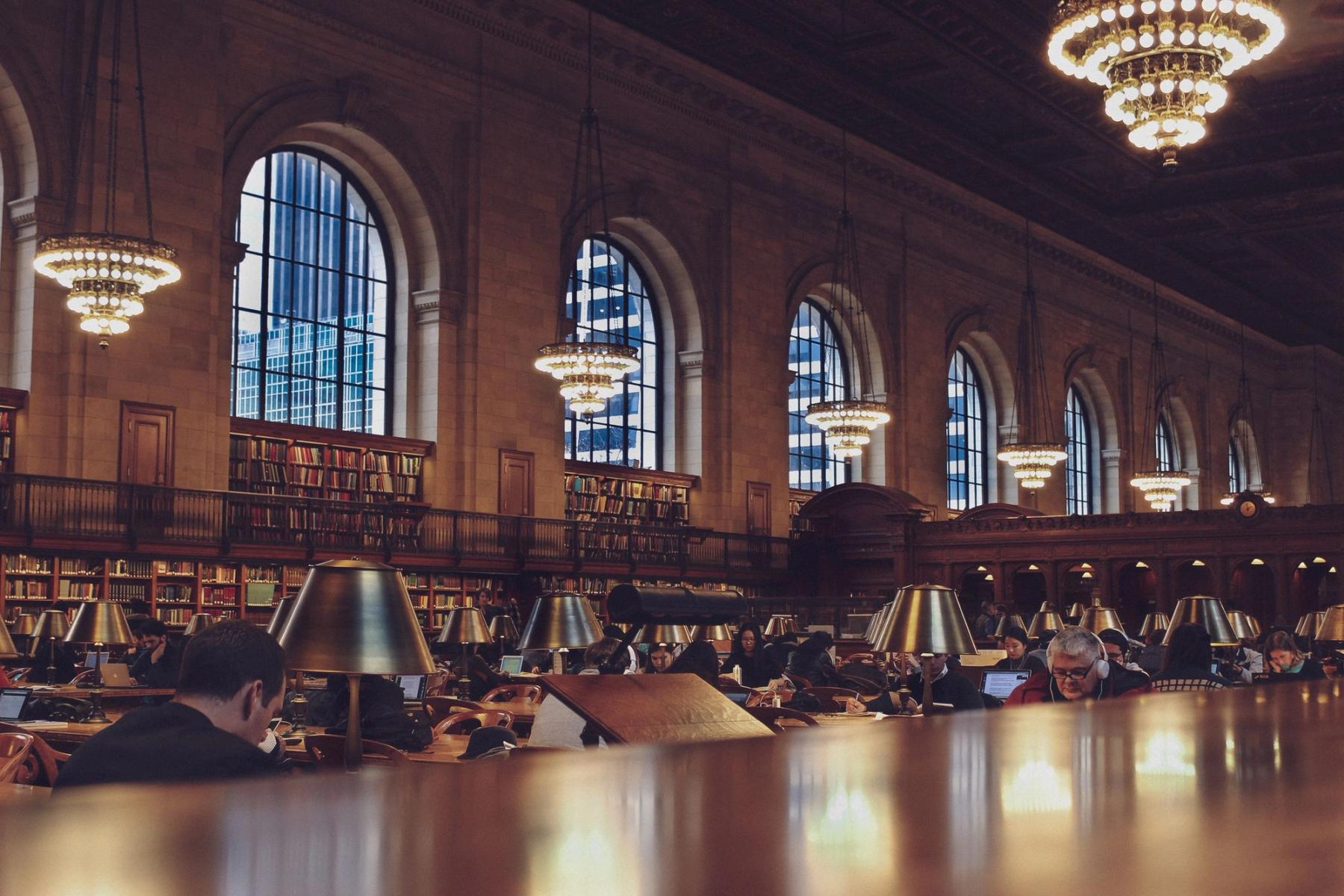
The reading room is full, but not silent. Pages turn, keys register small decisions, a chair moves and is corrected. Beneath the green lamps, concentration acquires the scale of public architecture.
Nora, preparing for a nursing examination in this scene, discovers that her pencil has broken. The stranger opposite slides another across the table without looking up. “Return it to the room,” he says later. It is a modest instruction and an exact definition of a library.
Outside, Fifth Avenue rewards velocity. Inside, the hour is divided by paragraphs. The building does not ask what each person is studying before granting them a desk beneath a painted sky.
At closing time, Nora leaves the pencil beside the lamp. Another reader takes her place before the warmth in the chair has gone.
A public reading room is one of the few interiors in Manhattan where a person may occupy valuable space without continually proving purchasing power. The desk is borrowed, the light shared, the time unpriced. This does not make the room free of rules; it makes its rules unusually legible. Speak softly, leave the place usable, and allow the stranger beside you the dignity of concentration.
Nora’s notes alternate between anatomy and reminders to call home. Across from her, the lender of the pencil is translating a page line by line. At another table, a researcher photographs a nineteenth-century advertisement while a teenager watches a geometry lesson through headphones. The room produces no single kind of knowledge. Its authority comes from holding unlike ambitions beneath one ceiling.
The grandeur could have made ordinary readers feel admitted on sufferance. Instead, repetition changes ownership. A person who returns each Tuesday begins to know which lamp flickers, where the afternoon light reaches and how long the security announcement leaves before closing. Familiarity turns monument into equipment.
There is also loneliness here, but it has a public form. People bring applications, obituaries, manuscripts and examinations they cannot discuss with the person at the next chair. They work among witnesses who know nothing of the stakes. The arrangement offers neither intimacy nor indifference; it offers company without demand.
Nora completes a practice test and circles a score she will not show anyone. Outside, the stone lions meet cameras and traffic. Inside, achievement is quieter: a paragraph understood, a reference found, an hour not surrendered to distraction. Institutions endure through such modest victories more than through their façades.
The borrowed pencil remains under the lamp. It is not a symbol until someone else needs it, and then it becomes a complete civic proposition: public wealth is sustained when use ends in return rather than possession.
The building itself was created from a merger of private collections and a public ambition. The Astor and Lenox libraries joined the Tilden Trust, whose bequest sought a free library and reading room for New York. When the Fifth Avenue building opened in 1911, more than a million books were already in place. Its magnificence was not conceived merely to house objects. It made access to knowledge visible as a metropolitan institution, on land where the Croton Reservoir had once stored another public necessity.
That history sharpens the contemporary question of what “free” means. Entry may cost nothing, but the reader still needs time, transport, confidence and sometimes proof that she belongs in a room designed at monumental scale. Staff, signs and predictable rules convert architectural permission into practical access. Without those mediations, grandeur can become another form of gatekeeping. Nora’s borrowed desk is public only because an institution continually performs the labour of welcoming her to it.
The library also sits within one of the world’s most expensive commercial districts. Around it, square footage is monetised by the hour, the lease and the transaction. Inside, a researcher may spend an afternoon following a question that produces no immediate revenue. This is not an escape from the economy. It is an investment in capacities whose return cannot be assigned neatly to one company or one quarter: literacy, memory, retraining, scholarship and the possibility of invention.
When the Rose Main Reading Room reopened after major ceiling inspection and restoration, the work included stewardship not visible in the finished room. Collections storage beneath Bryant Park expanded capacity for millions of volumes. The public surface of scholarship depends on engineering, conservation, cataloguing and climate control below it. Like the pencil, the room is simple only at the point of use; behind that simplicity stands a long chain of civic decisions.
The most moving thing in the room is not the ceiling but the permission to return. A person may fail an exam, lose a job, misunderstand a book and come back the next day to begin again beneath the same lamp. That continuity is a public good more durable than inspiration. It tells Nora, without promising her success, that her effort has a place in the city before it has a result.
The room’s publicness can be measured by the variety of futures it accommodates. A first-generation student, a retired teacher, an archivist and a writer with no publisher may use the same table for different reasons. The library does not flatten their circumstances, but it refuses to sort their right to concentrate by income. That refusal is quiet, expensive and politically significant. It is one of the reasons the room feels larger than its architecture.
The library’s grandeur is inseparable from the history of public provision. Its collections were assembled through private wealth, but the institution was created to make knowledge available beyond the households that had originally accumulated it. That tension remains. Philanthropy can build an extraordinary room; public stewardship determines whether the room continues to serve people who do not possess extraordinary means. The reading lamp is therefore both a symbol of generosity and a reminder that access must be maintained, not merely announced.
Nora studies beside a man translating a manuscript and a teenager preparing for a mathematics exam. Their aims are not equal in scale or security. One may become a career, another a credential, another a private act of recovery. The library does not promise that each effort will succeed. It offers something prior to success: the right to attempt a difficult thing in a room that does not ask for a financial explanation.
The city outside treats space as a scarce commodity. Inside, the table is shared according to rules that do not maximise revenue. This is why libraries remain economically radical even when they look traditional. They create value through duration, attention and collective memory, all of which are difficult to price. A reader may leave with no purchase but return with a capacity that later changes a family, a workplace or a field of study.
Nora leaves the pencil beneath the lamp because she has understood the institution’s quiet contract. What is borrowed should remain available to another person. The gesture is not sentimental. It is the smallest possible act of infrastructure: one user making the next user’s concentration easier. A public room survives through thousands of such decisions, long after the builders and donors have become names in a catalogue.
The reading room’s grandeur can make concentration appear effortless. It is not. A student has found a quiet place because the city has decided, through public funding and institutional care, that attention is worth protecting. The architecture gives that decision a visible form. A free table, a working lamp and a catalogue are modest technologies of equality, especially for people whose homes are crowded or whose work requires more silence than they can purchase.
The librarian who brings a requested volume does not ask whether the reader is important. That is the point. Public knowledge begins by suspending the usual hierarchy of credentials. It does not promise that every question will be answered, but it gives an unfamiliar person the same first permission to ask.
The library’s quiet is a public achievement, not a natural condition. It is maintained through cataloguing, cleaning, staffing, repair and the decision to keep knowledge available to people who may never become donors. The lamp above the desk is small, but it belongs to a large idea of citizenship.
The reading room’s most radical promise is that a person may arrive without a marketable reason. A student can consult a book before knowing whether the research will become a degree; an immigrant can learn the vocabulary of a new city; an older reader can spend an afternoon in a place that does not ask for a purchase. These experiences are difficult to quantify, but they are part of a city’s intellectual infrastructure. The library makes public the idea that attention deserves shelter. Every lamp is supported by catalogues, workers, repairs and civic decisions that could have funded something more immediately visible. That is why the room feels larger than its furniture. It is an argument about what a society owes to curiosity before curiosity has proved its value.
The great reading room makes a claim before a book is opened. It says that sustained attention deserves scale, height, ornament and light. In a city where valuable interiors are usually attached to purchase, employment or invitation, the claim is unusually generous. A reader may enter with a research grant, a job application, an unfinished novel or an examination guide and occupy architecture designed to feel consequential. The room does not make every project equal in outcome. It gives each project a public dignity at the moment of effort. That distinction is central to the idea of a library: equality is not the promise that all readers will succeed, but that serious tools should not be reserved for those who can buy private silence.
Nora's nursing examination brings the institution's purpose into practical focus. She shares an apartment with relatives whose schedules overlap, and concentration at home must be negotiated around calls, cooking and a child who rightly does not understand why an adult's textbook outranks play. The library offers no miracle. She still has to master pharmacology, manage work shifts and resist fatigue. What it supplies is a desk where the conflict over space has already been settled in her favour. Public provision often matters in exactly this way: it does not remove effort; it makes effort possible.
The borrowed pencil is almost too neat a symbol, yet its ordinariness protects it from sentiment. A stranger has an extra object and recognises a need without requiring a story. The instruction to return it to the room turns possession into circulation. Libraries operate through this ethic at a larger scale. Books, tables, electrical outlets, databases and staff expertise move value from private accumulation into repeated public use. The same resource can support a student in the morning, an unemployed worker in the afternoon and a historian years later. Wealth here is measured by how often knowledge can be used without being exhausted.
That circulation requires substantial labour. Librarians answer questions that arrive in disguised form: a request for a date may be part of a legal appeal; help with a computer may determine whether a benefits application is completed; a search for an obituary may carry a family's grief. Security staff manage an institution that must be welcoming while responding to real conflict. Cleaners restore rooms used by thousands. Conservators protect materials from the very handling that gives them meaning. The serene surface of the reading room is an operational achievement, and respect for the institution should include the people whose judgement keeps it both open and usable.
New York's public libraries have long served as infrastructure for arrival. Immigrants used collections to learn English, study civic systems, preserve languages and imagine professions closed to them elsewhere. The story can be told too triumphantly if it implies that books alone dissolved discrimination. They did not. But access to information changed the terms on which people confronted power. A person who could read a form, consult a directory or study for an examination possessed a tool that did not depend entirely on patronage. The library's democratic force lies in this transfer of capacity.
Today the digital divide enters the room through devices. Some readers arrive with laptops, paid databases and stable cloud accounts; others depend on public terminals and a timed session. Information may be technically online while remaining practically inaccessible behind subscription fees, complex interfaces or inadequate connectivity. Libraries have become translators between formal availability and real use. A staff member who helps someone retrieve a document or recognise a fraudulent site is not offering a secondary service. They are performing the contemporary equivalent of opening the catalogue.
Nora notices that the people around her are studying different versions of security. One prepares for a civil service examination, another edits a résumé, and a researcher photographs archival references. Their ambitions are private, but the room makes effort visible as a common condition. This matters in a culture that often presents achievement as the expression of individual talent detached from support. Every page read beneath the green lamps depends on public investment, institutional continuity and the willingness of strangers to keep noise within bounds. Merit has an architecture, whether or not success stories choose to mention it.
The library is also a climate refuge. On days of dangerous heat or cold, a public interior offers more than intellectual enrichment. It gives the body a regulated environment, water, toilets and a place to sit without explaining why home is unavailable or unsafe. This role can strain staff and budgets because libraries are asked to absorb needs created by failures in housing, health care and social services. The answer is not to retreat from welcome, nor to pretend librarians can replace an entire welfare system. It is to fund coordinated public support that recognises the library as a crucial door rather than the last institution left unlocked.
A man sleeping at a desk may be read by one visitor as a violation of the room's purpose. He may also be exhausted from a night shift, medication or life without secure shelter. Rules remain necessary; shared space depends on behaviour that allows others to use it. The challenge is to enforce those rules without turning visible poverty into moral contamination. Public institutions reveal their character in these difficult encounters. Grandeur is easy when everyone arrives rested, resourced and fluent in the code of the room. Democracy is tested when needs exceed the categories for which the building was designed.
The ceiling and long ranks of lamps produce a visual order that can feel timeless, but libraries have never been static warehouses. Collections change, classifications are revised, and new scholarship exposes absences created by earlier decisions about what deserved to be acquired. The authority of an archive depends not on claiming completeness but on documenting its limits. Which neighbourhood newspapers were preserved? Whose letters entered institutional custody? What languages are easy to search? These questions determine who can later appear in history as a fully evidenced person. Acquisition is therefore a form of public memory policy.
Nora's exam guide will not enter the rare-books division. Its pages are highlighted, practical and likely to be replaced by a new edition. Yet the knowledge it carries connects the reading room to hospitals across the city. When she studies dosage, infection control or patient communication, private concentration becomes future public competence. The line between culture and utility dissolves. A library worthy of admiration can protect singular manuscripts while supporting the ordinary manuals through which people learn to care for one another. Intellectual prestige and practical education need not compete for dignity.
During a break, Nora walks past exhibition cases containing objects whose survival seems improbable. The display reminds her that preservation is selective and expensive. Paper needs controlled conditions; digital files need migration; rights must be negotiated; descriptions must be maintained. The phrase "permanent record" can sound ceremonial, but permanence is a sequence of funded decisions. Neglected archives do not become neutral. They become inaccessible, corrupted or dependent on institutions wealthy enough to acquire what smaller communities cannot keep.
The reading room's rules establish a temporary republic of attention. Calls are taken outside, seats cannot be claimed indefinitely by unattended belongings, and the collective atmosphere limits individual preference. Such rules may feel restrictive precisely because many commercial spaces now treat the customer as sovereign. The library offers a different freedom: the ability to work because everyone accepts proportionate constraint. Nora cannot play music aloud, but neither must she buy another drink to justify her chair. Public liberty is often made from reciprocal limits rather than unlimited choice.
Funding debates tend to translate libraries into counts: visits, loans, computer sessions, programme attendance. Measurement is necessary for accountability, yet the deepest returns resist clean attribution. A reader gains confidence, a child sees an adult study, a researcher connects two records, or a stranger lends a pencil. Years later, a nurse may treat a patient differently because of an hour spent reading about communication under stress. No institution should be exempt from evidence, but evidence must be broad enough to include capacities that mature beyond the reporting period.
Outside on Fifth Avenue, private wealth announces itself through controlled access, polished lobbies and services calibrated to individual preference. Inside, magnificence is shared and therefore occasionally inconvenient. Somebody coughs; outlets are scarce; a requested book is unavailable. The imperfections are not evidence that public provision cannot rival private luxury. They reveal a different purpose. The room is not designed to remove every stranger from one's environment. It asks strangers to cooperate so that each may accomplish private work within a common institution.
Nora fails a practice test by two points. For several minutes, the room's grandeur feels almost insulting. Architecture cannot reassure someone who has calculated the cost of another examination fee and the weeks of study required. She considers leaving, then reviews the questions marked wrong. The public story of education often skips this unphotogenic stage: repeated failure managed without certainty that effort will be rewarded. The library's gift is not inspiration. It is continuity. The desk remains available when confidence does not.
At the next table, a school student silently points to a page Nora has dropped. Their exchange lasts seconds. The room contains hundreds of such acknowledgements, too slight to become relationships but sufficient to make solitary work less isolating. Public concentration is a paradox: everyone protects privacy by participating in a shared atmosphere. The spectacle is not that New Yorkers become quiet. It is that a city organised around competition can maintain a place where one person's attention is treated as something others have a duty not to destroy.
When the closing announcement comes, readers negotiate with time. Some pack immediately; others finish a sentence as if the institution might honour intellectual momentum over the clock. Staff move through the room with practised patience. Nora leaves the pencil beside the lamp and takes a photograph of the questions she will review on the train. The object is ready for another hand, but the gesture has changed her relationship to the room. She arrived as a user of a service and leaves as a minor custodian of its customs.
Weeks later, she returns after passing the examination. There is no ceremony and no guarantee that the same desk will be free. She brings a packet of pencils, places two in the centre of the table and keeps studying for the next requirement. This is how public institutions endure: not through gratitude demanded as deference, but through people who understand that benefit carries a modest responsibility to those arriving after them. The green lamps illuminate separate pages. Together they make a civic image of knowledge held not above ordinary life, but directly in its service.
Nora's eventual work places her in rooms where information arrives under pressure. Patients misunderstand instructions, families search phones for terms they have just heard, and clinical staff translate specialist knowledge into decisions that cannot wait for perfect comprehension. The library taught her a related ethic: access is not achieved when information merely exists. It is achieved when a person can find, interpret and use it. This makes clear communication a form of care rather than a simplification beneath professional status.
The packet of pencils gradually disappears. Nora never sees who takes them, which is appropriate. Public reciprocity does not require a ledger matching every benefit to a return. Taxes, donations, staff work and civic customs combine so that strangers may receive resources from people they will never meet. Trust weakens when this circulation is exploited, but it also weakens when every use is treated with suspicion. The library maintains a disciplined generosity: rules protect the common stock so that access can remain broad.
A year later, Nora enters the room on a day off and finds no seat. She feels the irritation of someone who has begun to regard the institution as part of her own story. Then she notices a reader bent over a nursing guide at the far table. The resemblance is imprecise but sufficient. She leaves without resentment and studies elsewhere. Belonging to a public institution means accepting that one's cherished access is valuable precisely because it cannot become private entitlement.
The green lamps do not illuminate a single democratic outcome. Some readers will obtain credentials, some projects will fail, and some information will be used in ways the institution would not endorse. Freedom of inquiry includes uncertainty. The library's duty is not to manufacture virtue from every visit, but to maintain conditions in which knowledge can be pursued within law, collections can be questioned and the historical record remains open to correction. That restrained mission is more powerful than inspiration because it survives disagreement.
The reading room will never know all that begins beneath its lamps. It cannot trace every certificate, argument, diagnosis, poem or change of mind to a particular hour at a public desk. This uncertainty is not a weakness in the case for libraries. It is evidence of freedom. The institution offers capacity without purchasing the outcome, allowing readers to carry knowledge into worlds beyond its supervision. Nora's pencils disappear into that same open future. One may break during an examination, mark a job application or be left untouched. Their value lies in being available before anyone has proved that the intended use will be impressive.
There is authority in an institution willing to be useful without knowing in advance which use will become prestigious. The future scholar and the exhausted applicant receive the same lamp; the rare volume and the practical guide belong to one ecology of learning. This breadth protects the library from becoming a monument to knowledge already recognised by power. It remains a place where significance can begin anonymously, in notes no curator has selected and in the patient rereading of a chapter that made no sense the first time.
New York’s most persuasive wealth may be this: a room magnificent enough for ceremony, held open for ordinary acts of attention.