

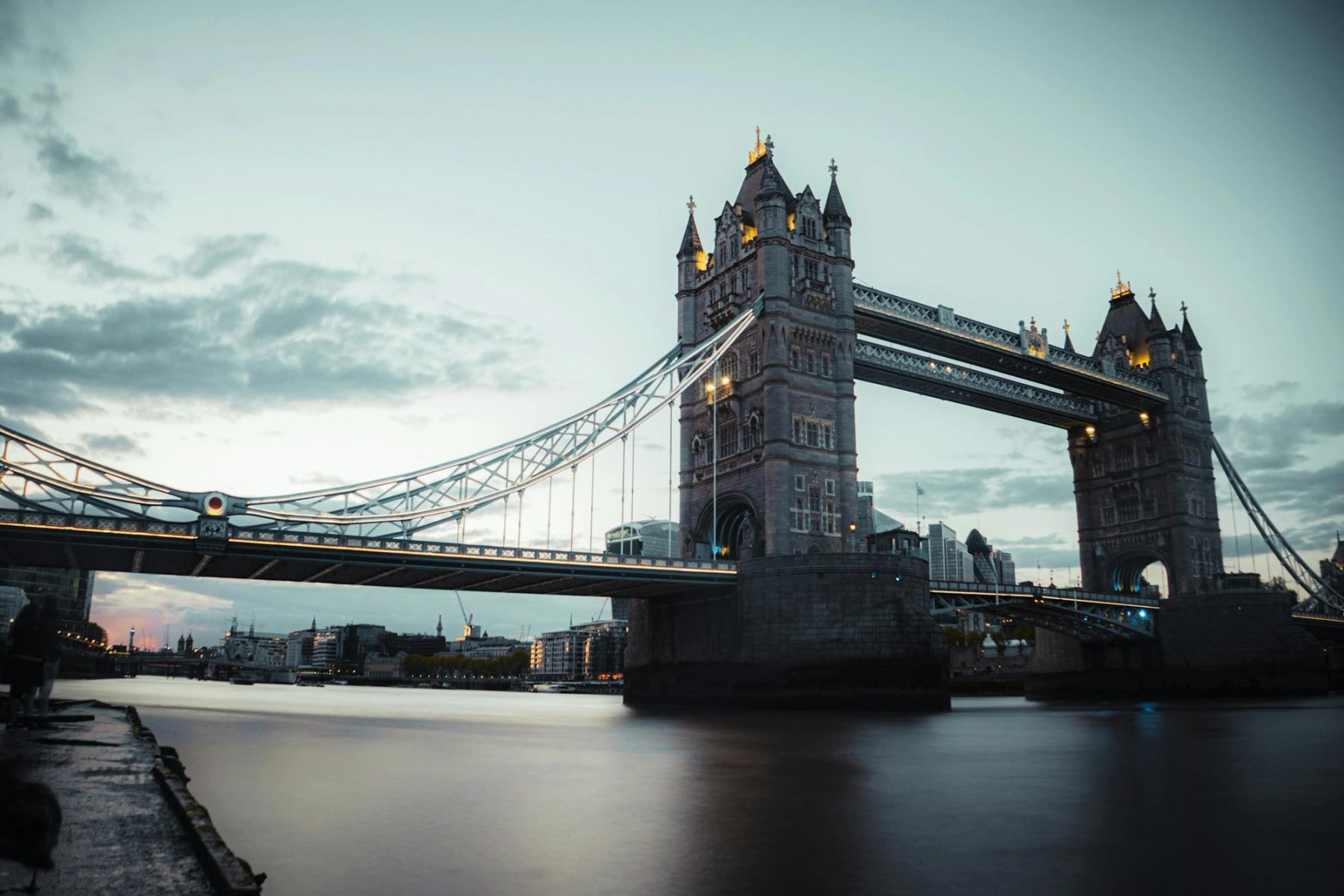
Editor’s note: Mara and the conversation in this city scene are editorial reconstructions. The bridge history and engineering details are drawn from Tower Bridge’s published archive.
At a quarter past eight, the lamps come on before the sky has fully surrendered. Tower Bridge acquires its familiar outline by degrees: first the pale chains, then the upper walkways, finally the two towers standing over water the colour of graphite. On the southern approach, a woman in a raincoat has stopped with one hand on a small suitcase. She is watching the roadway as if it might answer a question.
“Does it still open for ordinary boats?” she asks. Her name, for the purposes of this London scene, is Mara; she has arrived from Leeds and has ninety minutes before a train from Waterloo. A member of staff points towards the signal lights. The answer is yes. The bridge is not a stage set, although it has learned to tolerate an audience.
A horn sounds from downstream. Cyclists dismount. Taxis settle into a short, irritated line. Then the road divides and rises, slowly enough for the machinery to appear ceremonial. A river vessel passes through the opening and the crowd raises its phones. Mara does not. “I wanted to see whether London would really stop for water,” she says.
The city began building here in 1886. The work took eight years, five principal contractors and the labour of 432 construction workers on an average day. Iron caissons were sunk nearly eight metres below the riverbed. Behind the Gothic stonework stood a steel skeleton and a hydraulic system powered by steam. London dressed a machine in the visual language of inheritance.
Below each tower, counterweights of roughly four hundred tons descend into the bascule chambers when the road rises. The movement is immense but controlled. It is the opposite of spectacle’s usual trick: the visible structure seems heavy, while the hidden weight is what allows it to move with grace.
Mara looks from the Tower of London to the offices catching the last light farther west. “It cannot decide what century it belongs to,” she says. That is less a criticism than an exact description. From the river, fortress, warship, hotel, warehouse conversion and glass headquarters occupy the same sentence without agreeing on its tense.
The bridge was built because the East End needed another crossing without closing the Pool of London to shipping. Its most photographed feature is therefore the solution to a commercial problem. Pageantry came later, or perhaps pageantry was the method by which Victorian engineering obtained public consent.
When the roadway lowers, the crowd disperses almost at once. The taxis reclaim their impatience. A delivery rider accelerates towards the north bank. Mara wheels her suitcase away and says she will miss the train if she stays for another lift. The bridge has offered no revelation, only a rearrangement of priorities: for several minutes, the road yielded to the river.
London is often presented as an accumulation of institutions and addresses. The Thames supplies the necessary correction. It places them in a line, subjects them to weather and tide, and carries working traffic past buildings designed to appear permanent.
The bridge is often described as an emblem, but emblems conceal the negotiations that made them possible. Its second crossing was required because the East End was growing while the Pool of London still depended on shipping. The decision was therefore neither decorative nor inevitable. It was a compromise between movement on land and movement on water, between a port’s older economy and a city beginning to imagine itself through traffic.
That compromise remains visible in the bridge’s daily timetable. A lift can delay a taxi, a bus, a courier and a commuter, yet it also protects the river’s right to remain a working route. Modern cities tend to make water picturesque once industry has moved elsewhere. The Thames resists that conversion. Barge, tide and weather keep reminding London that its prosperity was built through systems that cannot be reduced to a view.
Mara’s suitcase is small enough to carry upstairs, but her hesitation belongs to a larger question about who gets to move through the city without friction. Visitors experience the bridge as a pause in an itinerary. Workers experience it as a decision about time. Residents experience it as a familiar piece of infrastructure that occasionally interrupts the day. The same opening has different costs depending on whose schedule is being measured.
The hidden machinery makes the point more forcefully than the stone. Counterweights allow immense leaves of roadway to rise with a kind of calm. Grace here is not weightlessness; it is weight accounted for. A city becomes elegant when it acknowledges the forces it depends on and designs them into a form that ordinary people can trust.
At the north bank, a school group gathers beside a delivery rider who is trying to photograph the signal. The teacher explains that the bridge was engineered to move; the rider explains that he has a delivery window. Both are right. London’s public monuments are most alive when they permit knowledge and urgency to occupy the same pavement without either being mocked.
When the bridge closes over the river again, the crowd resumes its separate purposes. Nothing has been solved. The shipping lane remains, the road clears and the river continues beyond the frame. Mara’s train is still in question. What she has witnessed is less a lesson than a scale: the city is not a solid object but a set of agreements that must keep moving if they are to endure.
A name can endure through centuries only when the thing it names remains answerable to use. Tower Bridge survives not because it has escaped history, but because history keeps passing beneath it. Its beauty is the visible surface of an older discipline: build for the present, leave room for the river, and do not confuse permanence with stillness.
The people who keep the river legible rarely appear in the photograph. A pilot reads a tide table; a bridge operator watches the signal; a maintenance worker inspects the place where water meets metal. Their knowledge is local, technical and accumulated over years. London’s confidence in the bridge depends on this knowledge more than on the stone towers that tourists recognise. A structure becomes civic when strangers can trust the expertise they will never personally witness.
That trust is not unconditional. The bridge belongs to a city dealing with rising water, ageing infrastructure, air pollution and an economy that increasingly treats every well-positioned address as an asset. Preservation can become a luxury if it protects appearance without protecting use. The river asks a harder question: what does it mean to keep a historic structure open to movement, repair and adaptation rather than freezing it as an image? The answer will be found in budgets, shift patterns and engineering decisions, not only in ceremonies.
Mara reaches the station late. She has missed the train, but not the crossing. On the platform she opens a message from her sister and sees that the small emergency for which she was travelling has already changed. The bridge has not solved anything for her. It has offered a scale in which private urgency can be held for a moment beside the patient force of water. She watches the river move below the platform and puts the phone away.
This is why the bridge endures as more than a landmark. It does not promise that history will make the present meaningful. It shows that meaning is made through continued use: by a road yielding to a vessel, by machinery lifting what seems immovable, by a worker checking the system before the crowd arrives. The most lasting cities are not the ones that deny change. They are the ones that give change a form, a memory and a public responsibility.
The bridge also exposes a question about public money. A landmark can generate tourism, property value and civic pride, but maintenance is not paid for by admiration alone. Inspections, energy, access and emergency planning compete with every other urban need. The decision to preserve a moving bridge is therefore a decision to keep technical knowledge in public life, even when a cheaper image might be easier to manage.
Mara remembers the staff member who answered her question without turning it into a performance. Expertise did not announce itself. It made the crossing possible and then stepped back. That modesty is one of the city’s best traditions: the public world is held together by people who allow the structure, rather than themselves, to receive the attention.
At the river, endurance is never passive. It is a sequence of decisions made by people who must respect inherited form while preparing for unfamiliar water, traffic and weather. The bridge matters because it remains answerable to the lives passing over and beneath it. Its dignity is not a pose; it is the visible result of continued care.
There is another London at river level, one that rarely survives the elevated view from a hotel room or the ceremonial approach to a bridge. It smells of wet rope, diesel, silt and the metallic cold that gathers beside moving water. Along the embankment, the city loses some of its confidence in straight lines. Steps vanish at high tide. Moorings pull against their chains. A gull opens a paper bag as efficiently as a customs officer. The river makes a practical inventory of whatever the capital would prefer to treat as scenery. It carries refuse and freight, reflects palaces and construction cranes, and puts the language of prestige beside the evidence of use. To walk here with attention is to understand that London was not placed beside the Thames as an ornament. Its political reach, financial habits and social divisions were formed through the work of a tidal river connected to a much larger world.
The bridge lift that Mara watches belongs to this working history, even when the vessel passing beneath appears modest beside the architecture. An opening is booked and managed, signals are checked, road traffic is stopped, and a sequence rehearsed over generations places one system of movement temporarily above another. For a visitor the event is theatre. For the bridge staff it is an operational responsibility; for a delivery driver it is delay; for the crew below it is access. Public infrastructure is often judged from only one of these positions. London works because institutions are required, at their best, to hold several positions in view at once. The bridge does not ask the river to become harmless before allowing it through. It assumes that the river has claims, and that the road must sometimes yield to them.
This principle feels almost archaic in a capital whose contemporary economy places a premium on uninterrupted speed. Financial instructions cross borders in milliseconds, meals are assigned delivery windows, and passengers are told precisely how many minutes remain before a train. Yet the river is governed by tide, weather, draft and the physical dimensions of a vessel. These are not failures of innovation. They are conditions that cannot be persuaded by branding. When the bascules rise, the road encounters a limit that has been designed into the city rather than concealed from it. The pause is valuable because it makes interdependence visible. A person may dislike waiting and still recognise that another route has legitimate priority. Civic maturity begins in that difficult space between inconvenience and consent.
On the north side, a bridge technician whom we will call Stephen finishes a visual inspection in the reconstructed chronology of this essay. His father worked on buses; his daughter writes software for a logistics firm. At family dinners, all three describe London through systems that become noticeable chiefly when they fail. Stephen distrusts the romantic language used about engineering. "You want it to be boring," he says of maintenance. "Boring means everyone went home." The line is reconstructed, but its professional ethic is real. The most consequential work in a city often aims to produce no spectacle at all: a bearing turns, a signal corresponds to the machinery, a barrier closes before the roadway moves. Reliability is a public art practised without applause.
Tower Bridge has always depended upon a division between what London displays and what it hides. The towers offer turrets, stone and a silhouette legible from almost any souvenir counter. Below them are chambers, counterweights, control systems and inspections. Victorian confidence was not merely decorative; it was also a confidence that heavy machinery could be incorporated into a civic image. The modern city has inherited the image while outsourcing much of its understanding. People know the bridge from photographs but may not know why it opens, who requests a lift, how the river remains navigable or what kinds of expertise keep the structure available. A mature heritage culture should not choose between beauty and mechanism. It should teach the public to see that the beauty is partly the mechanism made intelligible.
The riverbanks east and west of the bridge tell another story about visibility. Warehouses became apartments, wharves became promenades, and industrial addresses acquired the expensive calm of converted brick. Regeneration repaired contaminated land and returned stretches of water to public use, but it also changed who could afford to live near the view. The same tide reaches luxury balconies and housing estates, yet access to warmth, insurance, transport and secure tenancy remains sharply unequal. London often celebrates the democratic surface of the Thames: anybody can look at it. The harder question is who can remain beside it, whose labour maintains the riverfront, and whether public access survives when land values turn every edge into a commercial opportunity.
Mara's ninety minutes therefore contain more than sightseeing. She has arrived with the compressed knowledge of a traveller who cannot miss a connection. Every decision has an opportunity cost: cross the bridge, buy coffee, remain for another lift, or leave. Around her are Londoners for whom the same territory is not an interval but the architecture of work. A security guard beginning a shift, a cleaner travelling between buildings and a courier watching the barrier all inhabit the bridge differently. The city does not become more truthful when visitors disappear from the scene. It becomes truthful when tourism is placed alongside the schedules, wages and responsibilities that make the admired view possible.
The Thames has also become a measure of London's environmental future. Rising seas and more volatile weather do not arrive as abstract global concepts at a tidal river. They appear as calculations about flood defence, drainage, development and the lifetime of infrastructure. The Thames Barrier farther downstream is one expression of the city's capacity to turn risk into engineering. It is not a permanent absolution. Every defence has assumptions, operating limits and communities beyond its most protected line. The river's beauty after rain can coexist with serious questions about who receives protection first, who pays for adaptation and whether political time can be made to match environmental time. A city that thinks in centuries must learn to maintain what cannot be completed within an electoral term.
That requirement gives the bridge's Gothic dress an unexpected relevance. The design was intended to belong visually beside the Tower of London, to make new engineering appear compatible with inherited authority. Today the relationship can be read in reverse. The old-looking towers contain a structure that survives only through continuous revision: steam yielded to later hydraulic and electrical systems; components are inspected, repaired and renewed. Heritage is not the refusal of change. It is an agreement about which identity should remain legible while change takes place. London is most persuasive when it admits this. The capital's continuity has never depended on keeping every material untouched. It depends on institutions capable of altering the means without abandoning the public purpose.
Near the southern approach, the river is briefly hidden by construction hoarding. Renderings promise clean lines, planted terraces and people who seem never to carry shopping. The images belong to a familiar development language in which urban life appears after all conflict has been edited away. The real pavement is more complicated: a wheelchair user negotiates a temporary ramp, a family stops without warning, and a worker in a high-visibility jacket gives directions to a visitor while speaking into a radio. These interruptions do not spoil the city. They are the city. Design earns authority when it anticipates bodies that move at different speeds and when temporary works do not make accessibility optional. Monumental architecture cannot excuse an undignified approach.
At the river rail, Mara finally takes a photograph. She does not frame the entire bridge. Her image contains one raised roadway, a fragment of tower and the wake of the boat moving out of view. It is a better portrait than the symmetrical postcard because it records an event rather than an icon. Photographs can turn a city into evidence of possession: I stood here; I saw this. They can also register the limits of possession. The boat has already gone, the tide is changing, and the bridge will close whether or not the picture succeeds. London is not diminished by being unavailable to a single frame. Its authority grows from the sense that the systems continue beyond the visitor's attention.
The public life of the Thames is sustained by more than famous structures. It depends on boat crews, harbour authorities, engineers, emergency services, mudlarks with permits, environmental researchers, riverside businesses and residents who report what they notice. Their interests are not identical. Navigation can conflict with ecology; development can finance access while intensifying displacement; events can animate the riverfront while burdening nearby homes. There is no final design that dissolves these tensions. What matters is whether the institutions around the river can make decisions openly enough for competing claims to be heard, and competently enough for trust to survive disagreement. Ceremony without administration is decoration. Administration without public meaning becomes brittle. The river needs both.
As the evening deepens, office lights replace the colour in the sky. From the bridge, the towers of finance look almost weightless, their illuminated floors stacked above the dark water. The visual suggestion is misleading. Every digital economy rests on physical demands: electricity, cooling, transport, housing and the daily movement of workers. The Thames exposes this material basis because it predates the vocabulary through which the newest industries describe themselves. It has seen economies announce their modernity and then leave behind warehouses, docks and debts. The river does not offer moral judgement, but its banks preserve consequences. This is why looking from water level can feel more analytical than looking from a boardroom. The city becomes a sequence of uses rather than a hierarchy of brands.
Mara checks the departure board on her phone. She can still make the train if she walks quickly. Stephen, the technician, has already disappeared through a staff door. The vessel is downstream, its passage reduced to a widening disturbance on the surface. Nothing in the scene asks for sentiment, yet the arrangement produces it: strangers accepted a pause, hidden labour translated enormous weight into controlled movement, and an old river was allowed to interrupt a capital devoted to speed. The emotion is not nostalgia for a slower London. It is respect for a city that can still acknowledge obligations older and broader than the timetable of one traveller.
She reaches Waterloo with minutes to spare and finds that her train is delayed. The irony is ordinary enough to be useful. Systems demand punctuality from individuals while reserving uncertainty for themselves. Mara could treat the river stop as wasted time and the rail delay as proof that she should have stayed. Instead she remembers the road rising and the boat passing through. One delay had a visible reason and a choreography that made its purpose public. The other appears only as a changing line of text. The difference is not simply technical; it is civic. People accept inconvenience more readily when institutions explain what is happening, recognise the cost and demonstrate that somebody is accountable for putting movement back in order.
Long after she leaves, Tower Bridge continues its double life. It remains a national image and a municipal machine, a backdrop for private memories and a piece of regulated infrastructure. Its achievement is not perfect harmony between these roles. The bridge is compelling because the tension remains visible. Stone suggests permanence; steel permits movement. The road serves urgency; the opening respects passage. Visitors seek a symbol; workers maintain a system. London endures here through neither pageantry nor efficiency alone, but through the discipline of holding both in the same structure. The bridge performs permanence, as the earlier line suggests. The river keeps the performance answerable to reality.
The distinction between explanation and spectacle matters beyond the bridge. Democratic institutions ask people to accept constraints every day: taxes, closures, planning limits, security checks and waiting. Authority becomes legitimate when the reason can be understood, the burden is distributed with care and decisions can be challenged. The bridge lift offers an unusually clear version of this contract. Lights change, barriers close, machinery moves and a vessel passes. Nobody is asked to believe that delay is an unexplained necessity. The sequence makes the obligation visible. London could apply the same respect to less photogenic systems, especially those affecting residents with little power to avoid their consequences.
There is a final question in the bridge's longevity: what kind of institution is capable of maintaining a thing after the generation that built it has gone? Technical drawings matter, but so do apprenticeships, procurement rules, archives, budgets and a culture that values preventive work. A component cannot be repaired if knowledge of it has been allowed to disappear. Heritage therefore depends on education and employment as much as conservation. The bridge connects centuries not by standing alone, but by requiring one generation to explain its responsibilities to the next.
Mara later sends the partial photograph to her mother without a caption. The reply asks whether the bridge was broken. She types that it was opening, then notices how the two interpretations contain opposite ideas of movement. A road rising can look like failure if one assumes its sole purpose is to remain available to cars. Seen from the river, the same movement is fulfilment. Public debate often turns on this problem of vantage. The task is not to pretend every interest is identical, but to build institutions capable of showing why another person's route also belongs in the city.
The river's lesson is ultimately institutional rather than picturesque. Endurance is not achieved by declaring a name permanent, nor by placing an old silhouette on every new prospectus. It is achieved when people inherit a working purpose, understand the compromises inside it and possess the competence to revise the mechanism without discarding the obligation. Tower Bridge remains authoritative because it can still be opened for an actual vessel, maintained by actual workers and questioned by a public that uses both road and river. The centuries do not preserve a city as an image. They test whether its agreements can continue to move.
For the traveller, this leaves a useful discipline of looking. Ask not only what a landmark represents, but what it still does; not only who designed it, but who can repair it; not only how beautifully it occupies the skyline, but how fairly its burdens and access are shared at street level. Such questions do not diminish wonder. They give wonder an object sturdy enough to deserve it. The bridge is more impressive after the control room, maintenance schedule and contested riverfront enter the frame, because admiration no longer depends on forgetting the conditions of survival.
After dark, the bridge performs permanence beautifully. The river, moving beneath it, keeps the city honest.