

Editor’s note: Leon and the dialogue in this city scene are editorial reconstructions. Historical details are based on research published by the Central Park Conservancy.
From the air, Central Park looks like a refusal: eight hundred and forty-three acres withheld from the logic of the surrounding grid. At ground level, refusal is too simple a word. The park is crowded with uses. A runner checks her watch, a saxophonist tests three notes beneath an arch, and two men arrange chess pieces on a folding board whose missing black pawn has been replaced by a bottle cap.
The older player is Leon in this scene, a retired building superintendent from the West Side. He moves a knight and nods towards the towers above the trees. “People think the park is where the city stops,” he says. “The city is all here. It just has room to show itself.”
That room was designed, blasted, graded and planted. Frederick Law Olmsted and Calvert Vaux’s Greensward plan won a competition in 1858 by promising landscapes that would appear natural while separating walkers, riders and carriages with extraordinary precision. Workers moved millions of cubic yards of stone, earth and topsoil. The pastoral effect was an engineering achievement.
The park’s democratic reputation also has a prehistory that cannot be treated as a footnote. Between West 82nd and 89th Streets stood Seneca Village, founded in 1825 and inhabited largely by Black property owners alongside Irish residents. By 1855, it had about 225 residents, three churches and a school. The city’s acquisition of the land displaced them in 1857.
“A beautiful place can still owe somebody an explanation,” Leon says, studying the board. The line belongs to the fictional scene, but the problem is real. Every public landscape has two histories: the freedom it offers and the ground from which it was made.
A tourist from São Paulo asks whether the game is open. Leon gestures to the empty chair. No introduction is required. For twelve minutes, the board becomes a small republic of rules, bluff and shared attention. A child translates one move for her father. A dog pulls hard towards a squirrel. The city does not disappear; it becomes briefly negotiable.
Olmsted and Vaux hid transverse roads below the landscape so traffic could cross Manhattan without dominating the visitor’s view. It was a practical decision with a moral effect. Infrastructure was made to concede the foreground to common experience.
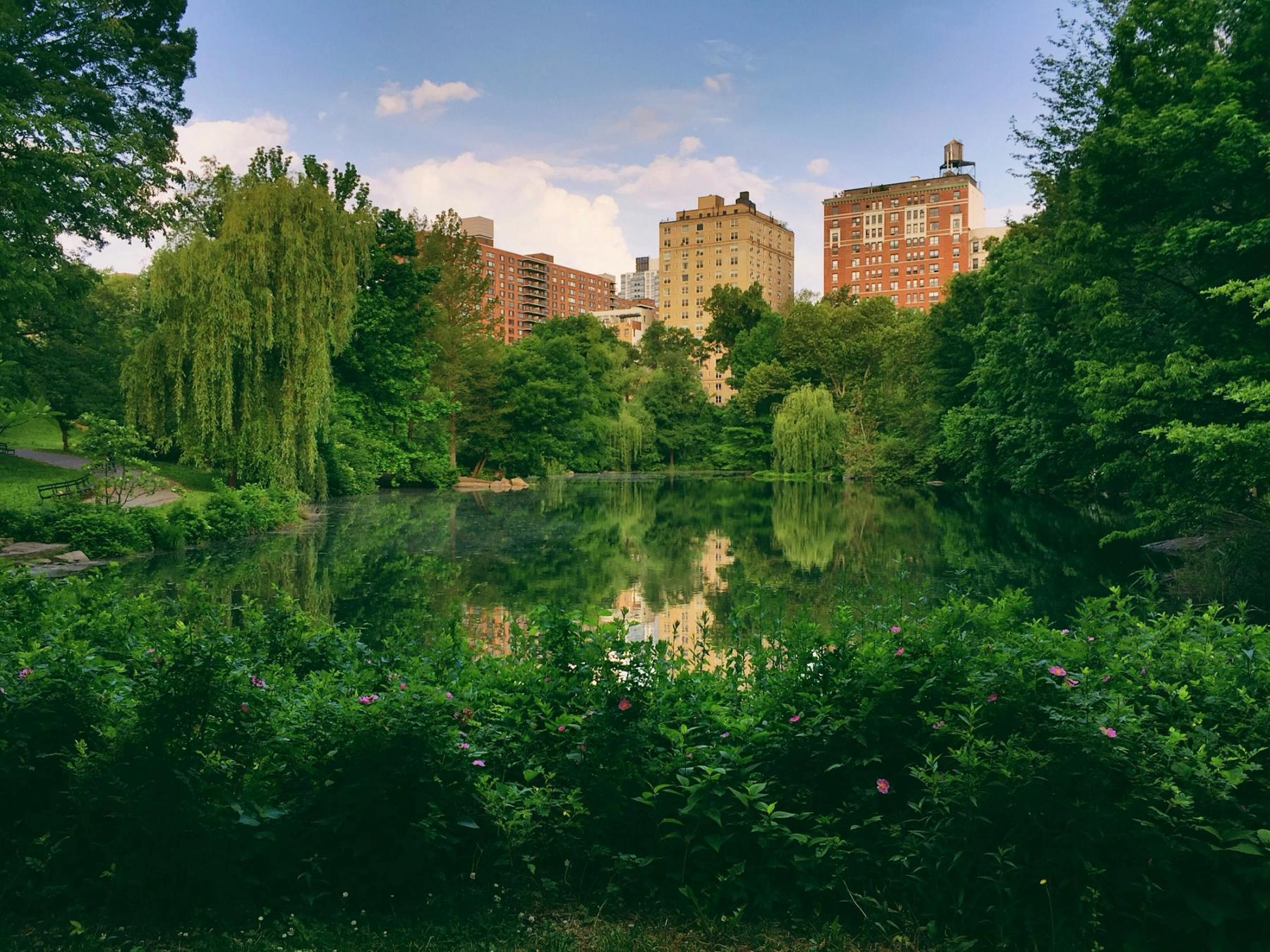
Near the edge of the park, the skyline returns all at once. Glass catches the afternoon while schist breaks through the soil below, geological time facing speculative time. New York’s habit is to announce the future in steel. The park answers with slower evidence: shade, wear, regrowth, a path polished by repetition.
Leon loses his substitute pawn and wins the game. He packs the pieces into a cloth bag. “Tomorrow, different people,” he says. The board, the bench and the patch of public ground remain available for the next arrangement.
Central Park’s apparent naturalness has always carried a civic argument. It proposed that a dense industrial city needed more than circulation and property; it needed a shared interval in which people could encounter a landscape not organised around purchase. The park’s designers used extraordinary engineering to make that interval feel inevitable. Soil was moved, rock was blasted, roads were separated and views were composed so that the public could experience freedom as a designed condition.
That design also had a price paid by people who were removed from the land. Seneca Village was not an empty prelude to the park. It was a community with property owners, churches, a school and social ties, predominantly Black alongside Irish residents. Remembering it changes the meaning of the green landscape. Public benefit cannot erase public loss; the park’s democratic promise becomes more credible when its own exclusions are part of the record.
Leon’s chessboard offers a smaller version of the same problem. The rules are open to anyone who sits down, but access still depends on confidence, time and the willingness of an established player to make room. A tourist may see a charming scene; Leon sees a practice held together by attention. The park does not create equality by itself. It creates conditions in which strangers can test whether they are prepared to behave as equals.
New York’s land values make the park’s unassigned space economically extraordinary. Every surrounding block can be measured through rent, office yield or development potential. The park is measured differently through shade, health, memory and the ability to spend an hour without buying admission. These benefits are not outside the economy. They support it, even as they resist being captured by a single owner.
The transverse roads buried below the landscape reveal the political intelligence of the plan. Traffic was not eliminated; it was placed beneath the experience of the park. Infrastructure was asked to serve the public without demanding the foreground. That idea has become urgent again as cities debate cars, deliveries, cycling and accessibility. The question is not whether movement should exist, but whose movement is allowed to define what everyone else sees.
A child loses the substitute pawn and retrieves it from beneath a bench. Leon waits rather than correcting the move. The delay lasts seconds, but it is the kind of delay public life requires. A city with no tolerance for interruption becomes efficient for machines and exhausting for people.
By evening, the park will be described in photographs as a green shape holding back Manhattan. At ground level it feels less like an interruption than an unfinished agreement. The paths, benches and clearings invite new arrangements every day. The durable achievement is not that Central Park has stopped the city. It has made room for the city to remember that not everything valuable must be converted into a grid.
The park’s argument is especially urgent in a city where the value of land is constantly translated into financial return. A tree canopy cannot be sold like a condominium, yet it lowers heat, offers shade, supports health and creates a common experience that would be impossible to purchase individually. The economic language of natural capital tries to make these benefits visible to policy. But the park also resists being defended only because it produces measurable savings. Some public goods matter because people need a place where their value is not the first question asked.
Leon has watched the neighbourhood around the park change from a place of working families into one of the most expensive addresses in the country. He does not romanticise the past; he remembers broken benches, difficult winters and the fact that public space was never equally safe for everyone. What concerns him is the disappearance of unplanned use. The bench where he plays chess has no reservation system, no minimum spend and no requirement that a person arrive with a reason that can be explained to a landlord or a platform.
When the tourist from São Paulo sits down, she asks whether the park is safe at night. Leon answers carefully. Safety is not a single condition, he says; it depends on light, people, policing, familiarity and whether a person feels entitled to call for help. The answer is not a slogan and does not fit the park’s promotional image. It is better than reassurance because it treats the visitor as someone capable of understanding a city’s unfinished work.
The chessboard is packed away before sunset. Leon walks home through a landscape designed to look timeless and sees the changes immediately: a new fence, a repaired path, a different group occupying the basketball court. A public park is never finished because the public is never one thing. Central Park remains powerful not because it has achieved a perfect democracy, but because it keeps presenting the city with a place where democracy can be practised, contested and remembered.
The park’s openness is also shaped by rules: hours, permits, maintenance schedules and the quiet decisions about which activities receive space. Freedom in a public landscape is never the absence of administration. It is administration that remembers the person without a membership card, the child without a programme and the older visitor who needs a bench more than an attraction.
Leon’s cloth bag is ordinary and easily lost. The value of the afternoon is not stored in it. It survives as a habit of returning, inviting a stranger to sit down and allowing a city divided by income, language and address to share a rule-bound hour. The park’s deepest architecture is this repeated permission.
The permission has to be defended in practical terms. It needs clean water, accessible paths, staff who can respond to danger and budgets that do not treat shade as decoration. Public space becomes durable when its ideals are translated into maintenance. A city can announce equality in a plan; it can demonstrate it in the condition of the bench.
The park is most persuasive before anyone tries to explain it. At the edge, traffic presses forward according to light cycles, fares and appointments. Ten steps inside, the sound does not vanish, but its authority changes. A path curves without apologising for the indirect route. Rock interrupts lawn. A person can sit without facing a counter or a screen that measures how long the seat has been occupied. This apparent release from the city is one of the city's most deliberate constructions. Central Park does not represent nature replacing urban order. It represents urban order making a difficult and incomplete commitment to land that cannot be used only for circulation, housing or sale.
That commitment was radical and compromised from the beginning. The landscape offered a shared ground to a rapidly expanding city, yet the process of making it displaced people whose own claims to the ground were treated as obstacles. Seneca Village matters not as a correction added to an otherwise triumphant story, but as evidence of how public benefit can be defined by those powerful enough to decide which public is being served. Black property owners there had homes, churches, a school and political stakes connected to ownership. Their removal is not cancelled by the millions who later found freedom in the park. The two histories must be held together if democratic space is to mean more than a beautiful outcome.
Leon knows this tension without using the language of planning history. His chess table is open, but openness has customs. Regulars recognise one another, understand who keeps pieces, and know when a spectator may offer advice. A newcomer must cross an invisible threshold. When Leon gestures to the empty chair, he is doing more than permitting a game. He is converting public space into welcome. Institutions can supply benches and paths; people decide whether those provisions become social territory. Access is therefore never finished when a gate is unlocked. It is completed, or withheld, through thousands of encounters that tell a stranger whether presence will be tolerated.
The park's pastoral design encourages visitors to imagine that the city has fallen away, but labour is everywhere in the effect. Arborists assess branches, gardeners manage soil, sanitation crews remove what crowds leave behind, conservators repair structures, and officers or stewards respond when ordinary conflict becomes unsafe. A landscape that looks natural can make maintenance invisible because success resembles the absence of intervention. This invisibility has political consequences. Budgets for care are easier to reduce when the public sees trees rather than skilled work. The question of who maintains common ground is inseparable from who gets to enjoy it and whether deterioration is allowed to concentrate in the areas used by people with less influence.
Private philanthropy has played a major role in the park's modern restoration and operation, offering expertise and resources that public budgets struggled to provide. The results are visible in landscapes recovered from neglect. They also invite a larger American question: what happens when a civic promise depends heavily on the generosity of wealth generated in the same city? Philanthropy can rescue public goods, but it should not relieve government of responsibility or allow affluent preferences to define the whole meaning of care. A park held in common needs transparent priorities, public accountability and sustained funding that does not fluctuate entirely with the willingness of donors to be associated with a particular view.
From the chess table, some of Manhattan's most expensive residential addresses rise beyond the trees. Their value is increased by proximity to a landscape no individual owner had to create. This is one of the park's economic paradoxes. Common land produces private wealth while offering refuge from the logic of property. The arrangement need not be treated as hypocrisy, but it should be recognised as a distributional choice. If public investment raises land values, cities must consider how some of that value can sustain broad access, affordable homes and the workers required to maintain the district. Otherwise the view remains public while the ability to live near it becomes increasingly inherited.
Leon worked in buildings whose residents often entered through a different door from the staff who kept those buildings running. He remembers when the distinction was explicit and when it became discreet without disappearing. In retirement, the park gives him a place where occupational hierarchy is less stable. The person across the board may be a lawyer, a teenager, a delivery worker between orders or a tourist who does not share his language. Chess creates equality only within the rules of the game, but even that limited equality has force. Each player must attend to the same pieces and accept a loss that money cannot reverse.
On hot days, shade becomes public health infrastructure. The difference between a tree-lined path and exposed pavement is not decorative, particularly for older adults, children and workers whose jobs keep them outdoors. As temperatures rise, parks are asked to perform more climate work: absorb rain, reduce heat, provide habitat and offer places where bodies can recover. These benefits are often described in aggregate, but their value is intimate. They determine whether a person can walk home, whether an apartment without adequate cooling remains bearable, and whether a child can play without the day becoming a medical risk. Climate adaptation is credible when it reaches the scale of such decisions.
The park is not equally comfortable for everyone after dark. Reputation, policing, lighting and personal history shape where visitors feel permitted to go. Public landscapes carry the wider society's patterns of surveillance and fear. A young Black man, a woman walking alone, a teenager in a group and a person sleeping outside may each be read differently by authorities and other users while occupying the same bench. Design can improve visibility and routes, but it cannot by itself remove prejudice from public space. Democratic access requires policies that protect safety without treating poverty, youth or racial difference as evidence of threat.
A woman named Camila joins the edge of the game in the reconstructed afternoon. She moved from Bogotá and works as a home health aide. Between appointments she has forty minutes, not enough to return home and too much to spend in a building lobby. The park gives the interval a place. She eats fruit, calls her mother and watches Leon's opponent lose a rook. Her use would be invisible in most surveys that categorise recreation. Yet cities are held together by such in-between time. Public space dignifies the hours that employment and transport leave unclaimed.
Olmsted and Vaux designed sequences of concealment and revelation: traffic passes beneath, paths separate, and the landscape delays the skyline before returning it to view. This is sometimes read as an escape from urban conflict. It can also be understood as training in attention. The path refuses the most efficient line so that distance becomes experience rather than waste. Modern platforms promise to optimise every journey, choice and pause. The park preserves a counterargument. Human judgement can be improved by routes that allow discovery, uncertainty and a change of mind. Not every detour is inefficiency; some are the spatial form of thought.
The reservoirs, lawns and wooded sections do not serve identical publics or require identical forms of protection. A major event can introduce thousands of people to the park and damage ground that needs months to recover. Quiet habitat can conflict with demands for more access. Athletic fields are essential to users whose activity cannot simply migrate elsewhere. Governance involves choices among legitimate goods, not a simple contest between use and preservation. The best decisions make trade-offs explicit and explain whose evidence was considered. Public trust weakens when closures or privileges appear to be negotiated privately, even when the physical outcome is attractive.
Near the table, a boy asks Leon whether the bottle cap is really allowed to be a pawn. Leon says that it is allowed if both players agree. The answer is an elementary lesson in institutions. Rules create a shared structure, but institutions remain alive through interpretation, consent and the ability to accommodate what is missing. The substitute piece does not weaken the game. It enables play to continue without pretending the loss never occurred. Central Park's future requires a similar honesty: acknowledge damaged histories and present inequalities, then build agreements strong enough for public life to proceed without erasing them.
New York repeatedly treats land as a test of imagination and power. Towers promise more value through height; streets convert frontage into movement and commerce; neighbourhood plans rearrange density. The park's resistance to development is therefore an active achievement, renewed whenever fiscal crisis or competing demand makes open land appear underused. "Underused" is a dangerous word when applied from a spreadsheet. A lawn storing stormwater, a path supporting a worker's walk, and a bench holding a solitary afternoon may produce little direct revenue. Their return appears across health, social trust and the basic conviction that the city contains something not reserved for the highest bidder.
Camila leaves before the game ends. Leon never learns her name. This lack of connection does not make the shared interval meaningless. Urban writing often forces strangers into revelatory conversation because narrative wants an exchange it can quote. Most public life is less obliging. People witness one another without becoming characters in each other's biographies. The civic value lies partly in that modest exposure: the city remains populated by specific bodies rather than abstract categories. Camila saw the patience with which Leon explained a move; Leon moved his bag so she could sit. Nothing more was required.
At the park's edge, the grid returns with the abruptness of a demand. Crosswalk signals count down, traffic accelerates and shop windows restore the logic of price. The park has not solved the housing crisis, corrected its founding displacement or made urban society equal. It has offered a space in which other arrangements can be rehearsed, including the possibility that valuable time may have no commercial assignment. This is not escapism if the experience alters what citizens expect elsewhere. A person who has felt shade, room and unpriced welcome may become less willing to accept streets designed solely for throughput.
Leon packs the board after a final game. The bottle cap goes into the same cloth bag as the carved pieces because its history has become part of the set. Across the path, workers close a damaged section of lawn so it can recover. The temporary restriction will frustrate somebody tomorrow, but care sometimes requires withholding use in order to preserve future access. This is the park's recurring discipline: freedom supported by limits, spontaneity held within maintenance, public pleasure made possible by decisions that remain open to scrutiny.
From above, Central Park will continue to look like a green refusal inside Manhattan. From within, it is better understood as a negotiation that never reaches final form. The ground carries displacement and welcome, engineered scenery and living ecology, immense private advantage and indispensable public benefit. Its authority depends on refusing the comfort of a single story. When Leon offers the chair to the next stranger, he does not resolve those contradictions. He performs the smaller democratic act on which the larger promise rests: there is room, the rules can be explained, and the game may begin before either person knows who will win.
The recovery of Seneca Village through archaeology, scholarship and public interpretation shows how an institution can change its own account. The work does not restore the homes or reverse the taking of land. It gives descendants and visitors a more exact basis for memory and makes displacement part of the park's civic education. This matters because public institutions often fear that acknowledging harm will weaken attachment. In practice, a record capable of correction is more trustworthy than a polished legend. Affection matures when it can survive evidence.
Camila later brings the person she cares for to a shaded bench near an accessible path. The outing requires planning: medication, toilets, curb cuts and a return before fatigue becomes distress. For her client, the park is not unassigned leisure but a carefully constructed freedom. For Camila, it remains work, though work softened by air and trees. Their different experience of the same hour resists a simple photograph. Public space is at its best when it can hold care without turning either caregiver or recipient into a spectacle.
A park that refuses the grid should also refuse the idea that only visible activity proves value. Sleep, recovery, mourning and solitary attention belong in a city whose residents are constantly asked to perform productivity. This freedom must coexist with safety and ecological limits, but it should not be designed away through hostile surfaces or relentless programming. Empty time is not empty use. It is one of the few public resources that can be taken without leaving less for the next person.
The park's refusal is not passive. Each generation must refuse a new argument that common land is empty unless monetised, that difficult history should be softened for pleasure, or that public welcome can be delegated entirely to private generosity. It must also refuse complacency about whose comfort is protected. Leon's offered chair is small against these demands, but democratic culture is made credible through repeated acts at that scale. The public institution maintains the ground; a person makes room; another person risks sitting down. The game begins with inherited pieces, one substitute and rules open to explanation. That is not a perfect city. It is a city still capable of practice.
The park cannot carry every demand placed upon an unequal city, and it should not become an alibi for failures beyond its walls. Green space does not substitute for housing, health care or just employment. What it can do is establish a public standard: land may be managed for shared use, beauty may be available without a purchase, and historical truth may deepen rather than cancel attachment. Those propositions leave the gate with every visitor. The more demanding work begins when the city is asked why they should stop at the park's edge.
A city proves its confidence not only by what it builds, but by what it keeps open to encounter. Central Park’s finest luxury is not emptiness. It is unassigned possibility.