

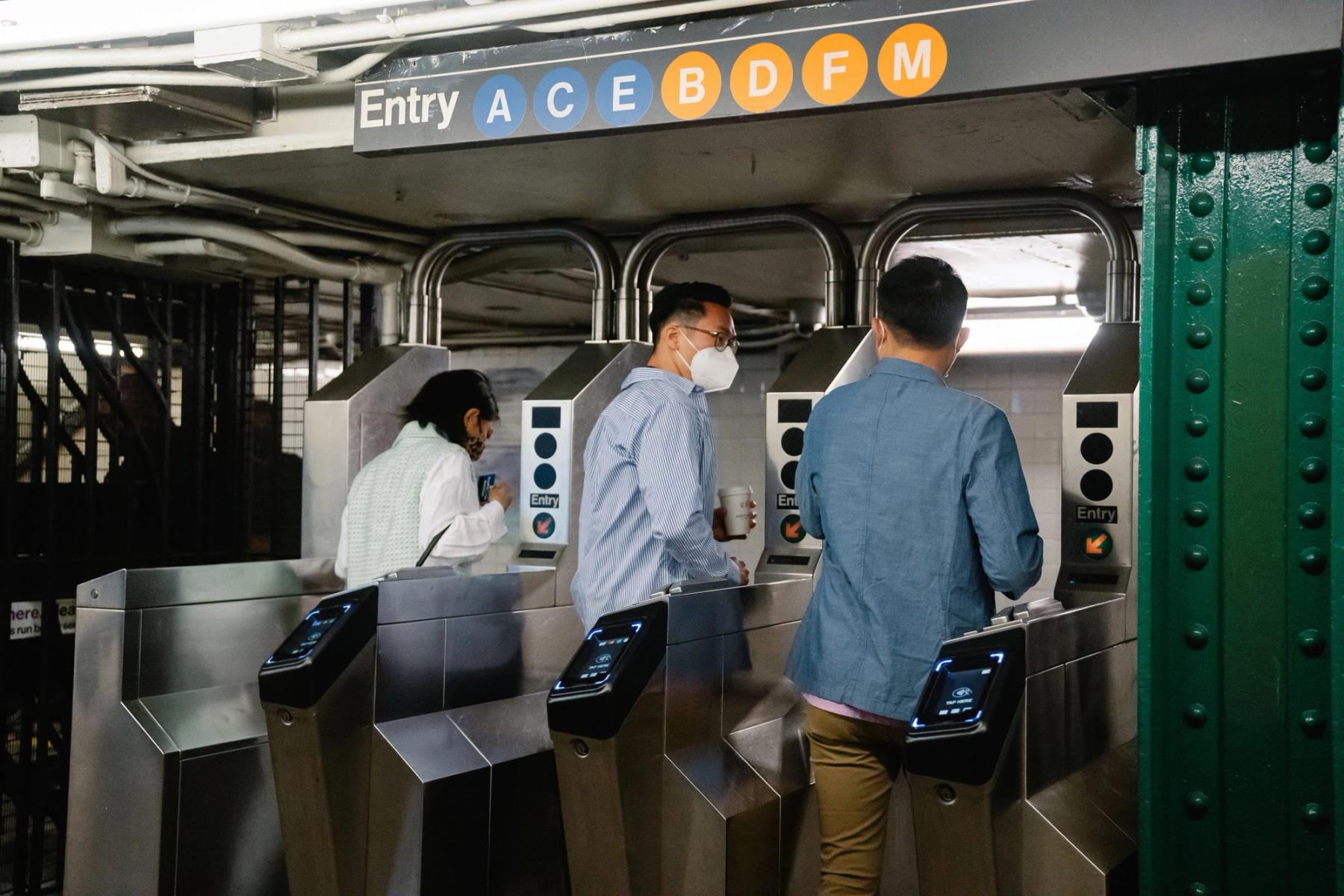
Editor’s note: This subway encounter is an editorial reconstruction.
At 8:42, the turnstiles translate intention into rhythm: tap, green light, shoulder, step. A failed card breaks the sentence. The people behind it redistribute their impatience without speaking.
A man carrying a cello case holds the gate for a parent with a stroller. “I take up too much room professionally,” he says in the imagined scene. The joke earns exactly one laugh before the train arrives.
On the platform, occupations disappear into coats and headphones. A courthouse clerk, a cook, a student and a musician stand along the same yellow line, temporarily governed by the same delay.
The train opens. Courtesy becomes tactical, bags rotate, bodies compress, and somebody reads three pages while standing between stations.
The fare gate is where the abstraction of a transport system becomes personal. A balance is insufficient, a sleeve catches, a child passes too slowly. Each interruption exposes the dependence beneath metropolitan confidence. Nobody moves through New York alone; everyone relies on machines, schedules and the restraint of the person waiting immediately behind.
The musician’s cello case changes the geometry of the carriage. Knees turn, a backpack moves to the floor, one passenger refuses to yield and another compensates. The adjustments are too small to be called generosity, yet without them the journey would fail. Public life often survives through gestures beneath the threshold of virtue.
Above ground, neighbourhoods are sold through boundaries. Underground, those boundaries become station names heard in sequence. Wealth, work and precarity enter the same car but do not become equivalent. The subway’s intimacy can reveal inequality without solving it: who is tired, who is carrying tools, who has time to wait for the next train.
At the next stop, an announcement is unintelligible. Passengers look at one another for translation. A woman removes one earbud and supplies the missing platform number. For a moment, information moves horizontally rather than from the system above. The carriage repairs a failure with collective attention.
The musician exits before the parent and stroller. The space he occupied closes instantly, filled by two new bodies and a folded bicycle. New York offers few monuments to accommodation because accommodation is consumed as soon as it occurs. The evidence disappears into resumed motion.
To write the city only from towers and avenues is to miss its daily grammar. The turnstile, the yellow line and the shared pole are punctuation marks in a sentence millions revise together, usually without introduction.
The subway was built to compress distance in a city whose employment and housing markets were expanding beyond the walkable core. It still performs that economic task, but unevenly. A delayed line can cost an hourly worker wages, a late pickup fee or a warning from a supervisor, while the same delay becomes an inconvenience absorbed by someone with schedule control. Shared infrastructure distributes service broadly; it does not distribute the consequences of failure equally.
Fare enforcement makes this inequality visible at the gate. The turnstile is both accounting device and moral theatre, where access, evasion and punishment are interpreted in public. Yet the system’s true finances extend beyond each tap. Employers rely on workers arriving from distant boroughs, property values respond to proximity, and the city’s cultural life assumes that audiences and staff can cross neighbourhood boundaries after dark. The ride is purchased individually while its benefits are collected collectively.
Inside the carriage, difference becomes physical without becoming intimate. Riders infer occupations from uniforms, income from shoes, exhaustion from posture, though each judgement may be wrong. The city’s mythology celebrates this proximity as democratic. A more honest reading recognises both contact and withdrawal: people share air and delay while using books, phones and headphones to defend a narrow zone of privacy.
The cello case disrupts that defence. It asks others to move and makes a cultural object materially inconvenient. In another setting, the instrument might signify refinement; underground it is luggage with awkward dimensions. This reversal is useful. The subway tests prestige against the same constraints imposed on groceries, tools and strollers. Everything must fit, and when it does not, strangers decide whether the system will be interpreted narrowly or with grace.
At the final station, the musician carries the cello up the stairs into a cold street. The city above has not become more equal because strangers moved their knees for him. But a possibility was rehearsed: public systems can ask people to share limits without treating inconvenience as a reason to exclude one another. The smallest accommodations are not sentimental. They are the daily grammar by which a metropolis decides who belongs in motion.
When the train arrives, the cello is held upright between strangers. The musician apologises, the parent says it is fine, and the carriage begins moving again. The exchange is forgettable by design. Yet a metropolitan system is made from such forgettable agreements. The city’s greatness is not that it eliminates friction; it is that millions of people repeatedly decide friction does not have to become exclusion.
The subway’s economic importance is hidden by its daily familiarity. It allows employers to draw from a metropolitan labour pool, students to reach schools, patients to reach hospitals and cultural audiences to cross neighbourhood boundaries. Yet the burden of its reliability is uneven. A delay costs different people different things. The salaried commuter may lose patience; the hourly worker may lose pay. A system can be public in reach while unequal in consequence.
The turnstile makes the moral language of transit unavoidable. A failed card can look like an individual problem even when it reflects a broader problem of bank access, fare burden or digital payment dependence. The gate recognises a valid transaction, not the conditions that produced it. That is efficient, but it can also make the city forget that mobility is a condition of participation rather than a simple consumer choice.
The cello case interrupts the geometry of the carriage because it carries a form of culture that is awkward, expensive and alive. The musician has a rehearsal; the parent has a child; the commuter has a schedule. None can claim the whole space. Their small negotiation shows what democratic infrastructure actually requires: not harmony, but a rule that allows incompatible needs to remain in contact without turning one person into a nuisance by definition.
At the next station the musician exits. The space closes and another passenger takes it. The city does not preserve the memory of the accommodation, yet its future depends on such accommodations recurring. New York’s transit is a machine, but the city that lives through it is made of people willing, sometimes reluctantly, to adjust their bodies for a stranger.
The subway’s roughness is often treated as a character trait, as if delay were part of New York’s charm. That romanticism hides a distributional fact: a late train is a minor inconvenience for one passenger and a missed shift, lost childcare or unpaid hour for another. The system’s daily drama is also an argument for investment. A city that depends on movement cannot make precarity part of its personality.
At the platform, strangers exchange information more readily than names. Someone points towards a less crowded car; another warns of a broken escalator. These gestures are not sentimental proof that the city is kind. They are practical adaptations to a shared dependence. Public life begins in the recognition that nobody controls the whole network alone.
The turnstile does not ask for a biography. It asks for a fare and then admits a person into a shared system. That modest equality is easy to overlook until the system fails. The city’s future depends on treating mobility as a public right supported by labour, investment and care.
The subway is an imperfect public institution, and its imperfections should not be disguised as charm. A delayed train can mean a lost wage, a missed appointment or an extra hour of unpaid care. Yet the network remains one of New York’s great democratic instruments because it allows people who would otherwise be separated by distance and income to occupy one moving system. The turnstile is the point where that promise becomes physical. It is narrow, impersonal and equal in its demand. Beyond it, the city is available. The question for the future is not whether the system can be made glamorous. It is whether investment, maintenance and respect for workers can make the promise reliable enough that ordinary movement does not become an act of private endurance.
The platform makes the argument visible in bodies. A nurse, a student, a cleaner and a lawyer may enter through the same gate, but each carries a different cost when the system breaks. Public transport is valuable not because it creates a charming crowd, but because it turns separate obligations into a shared route. The task of the city is to make that route dependable enough that the people with the least spare time are not asked to absorb every failure.
The turnstile reduces the city to a binary instruction: permitted or not permitted. Yet the person approaching it carries circumstances the machine cannot read. A card may lack value because payday is tomorrow, because an employer changed a shift, because a fare cap was misunderstood or because the payment system failed. The gate records an outcome, not a biography. This is useful for moving millions of people and dangerous when the record is treated as a complete account of behaviour. Infrastructure needs simple rules to function. Justice begins when institutions remember that simple rules encounter complicated lives.
The musician with the cello case is named Marcus in this reconstruction. The instrument was not his family's idea of a secure profession, but it has taken him into classrooms, theatres, recording sessions and weddings across the boroughs. Every journey requires geometry. He identifies wider gates, avoids stairs when possible and knows which carriage gives him the best chance of fitting without turning the case into a weapon against strangers. Accessibility is often discussed as a minority concern; Marcus's route shows how quickly any unusual body, object or responsibility exposes the assumptions built into transit.
A parent with a stroller, a traveller with luggage, a worker on crutches and a person who uses a wheelchair do not need identical solutions, but all benefit when stations provide clear, maintained step-free routes. The presence of an elevator on a map is not enough if it is difficult to locate, out of service or connected to a path that requires multiple unpaid transfers. Access must be understood as a complete journey. A broken link can make an entire network unavailable, transferring cost into taxis, missed appointments or dependence on another person.
New York's subway is both an engineering inheritance and a continuing political argument. It made the scale of the modern city possible by linking labour and housing across distance, yet the burdens of delay are not evenly distributed. A salaried worker may be able to send a message and absorb twenty minutes. A cleaner can lose wages, a home health aide can leave a patient waiting, and a parent can incur a late fee at childcare. Reliability is therefore not simply a customer-service metric. It is part of the distribution of economic security.
The fare debate condenses larger conflicts about public goods. Riders are asked to pay because operation costs money and the system requires stable revenue. The city also depends on the subway so thoroughly that access resembles a condition of participation in urban life. When enforcement focuses intensely on unpaid entry while other forms of loss receive less visible attention, people ask whose violations are treated as threats to order. A durable policy must protect revenue without criminalising poverty or encouraging dangerous encounters over a price that public policy itself has set.
On the platform, Marcus stands beside Elena, a courthouse clerk carrying files she was not allowed to send electronically. The delay announcement gives no estimate. She calculates whether to leave for a bus, knowing that changing routes can convert a manageable delay into a much longer one. Transit users develop expertise in uncertainty: they read crowd behaviour, listen for movement in the tunnel and judge the credibility of an announcement by its wording. This intelligence keeps the system usable, but riders should not be required to compensate endlessly for inadequate information.
A train arrives already crowded. The choreography at the doors is not natural New York aggression; it is behaviour shaped by frequency, platform width and the fear that another train may not come soon. When service is dependable, people can let a crowded carriage pass. When it is not, every opening becomes scarce. Scarcity changes manners. It rewards the person willing to push and punishes the person who needs more time. Operational investment therefore produces social effects that no campaign for courtesy can achieve on its own.
Inside, the cello occupies the space of two standing passengers. Marcus apologises before anyone complains. This anticipatory apology is familiar to people whose bodies or responsibilities do not fit standard dimensions. The city asks them to announce awareness of the inconvenience they may cause, even when the system offers no alternative. A genuinely accessible culture would shift some of that burden from individual politeness to collective design. The question should not be whether Marcus can make himself smaller, but whether public transport can accommodate the actual variety of public life.
The subway car is often romanticised as a democratic cross-section, a place where wealth and poverty share the same metal enclosure. Proximity is not equality. Some riders have private alternatives, flexible time and homes near frequent service; others depend on the network for every essential journey. People may stand beside one another while carrying radically different exposure to failure. Still, proximity has civic value. It prevents the lives that sustain the city from becoming entirely invisible to those who benefit from their work.
Maintenance takes place in a system that is expected never to stop. Tracks, signals, power, drainage and stations must be repaired around continual demand. Closures frustrate riders, particularly when alternatives are poor, but deferred work eventually appears as breakdown. The political difficulty is temporal: elected leaders and passengers experience immediate disruption, while the benefit may be a failure that does not happen years later. Serious infrastructure policy requires a language for valuing prevention. Like health, reliability is most easily taken for granted when it is successfully maintained.
At the next station, an announcement asks passengers to move for a person needing medical assistance. The phrase can produce compassion or irritation depending on how late everyone already is. This emotional volatility is part of public transport. Strangers become aware that one person's emergency has entered hundreds of schedules. Institutions should not shame frustration, but they can reduce the conflict by providing credible information and sufficient service resilience. People are more capable of generosity when uncertainty is not allowed to expand without explanation.
Elena thinks about the courthouse, where missed time is converted into formal consequences. A person arriving late may lose an appointment, fail to answer a case or appear indifferent to a process that rarely accounts for the geography of getting there. Public systems often operate as if other public systems were perfectly reliable. Courts, clinics, schools and benefits offices can compound transit failure through rigid lateness rules. A more intelligent city would coordinate its assumptions, recognising that access includes not merely a route but institutional tolerance for predictable disruptions.
The subway's visual language has long been admired for clarity: lines, colours, letters and a map that turns complicated geography into a navigable proposition. But every map is a promise that must be tested against the station. A symbol for accessibility, a listed transfer or a service notice has moral weight because somebody may organise an entire day around it. Design authority is earned when information corresponds to reality, updates arrive in time and the passenger is not blamed for trusting the system's own representation.
Marcus exits at a station without the easiest connection and carries the cello up a flight of stairs one step at a time. A stranger takes the lower handle without asking. The help is welcome, but it should not be used as proof that New Yorkers can improvise around inadequate access. Heroic assistance is an unstable substitute for infrastructure and can create risk for both people. The better city is not the one in which kindness repeatedly rescues a difficult journey. It is the one in which kindness is free to become companionship rather than emergency equipment.
The turnstile itself is changing as payment becomes more digital. Contactless systems can speed entry and reduce the need for a dedicated card, but they also raise questions about data, banking access, errors and the recourse available when technology refuses a valid journey. Convenience should not require every rider to possess the same device or financial relationship. Cash options, clear receipts and human assistance remain part of inclusion. A city does not become modern by removing friction only for those already best equipped to navigate it.
At the courthouse, Elena arrives four minutes late and finds that the hearing before hers is still in progress. The threatened consequence dissolves by chance. Marcus reaches rehearsal with a red mark across one hand from the case. Their journeys will never appear together in a report, yet both were shaped by the same delay and by the small decisions of strangers in response. Transit creates a public not because passengers share an identity, but because their separate obligations become dependent on a common system.
The grammar of the turnstile is therefore more than tap, light and passage. It includes exceptions, repair, explanation and the right to contest an error. It includes the wider gate, the elevator that works, the fare policy that recognises hardship and the service frequency that permits courtesy. A sentence becomes meaningful through relationships among its parts. So does a network. New York's subway speaks with authority when each rider can understand the instruction, enter without humiliation and trust that the route will treat their time as something the city is obliged to value.
On the return journey, Marcus hears another cellist playing through headphones worn by a teenager across the car. He cannot know this; the detail is imagined, but it belongs to the subway's real capacity for accidental correspondence. They travel for three stops without speaking. When Marcus leaves, he turns the case sideways so the door can close. The teenager looks up, recognises the shape and nods. Public transit does not resolve difference. It gives difference a route, and sometimes, between one gate and another, a moment in which separate lives recognise that they are moving through the same score.
The people who operate the system face the same compression of biography. Riders see a uniform or hear an announcement; behind it may be a worker managing abuse, outdated equipment and instructions that changed during the shift. Accountability should not become permission to direct institutional anger at the nearest employee. Leadership earns trust when it gives frontline staff accurate information, authority to solve ordinary problems and protection from being made the human surface of every policy failure.
Elena later uses the delay in a conversation at work about late arrivals. She cannot change court rules alone, but she asks whether the first response must always assume irresponsibility. The question moves slowly through procedure. This is how systems sometimes become humane: not through a single heroic reform, but when workers carry knowledge from one public institution into another and challenge an assumption that had become invisible through repetition.
Marcus's cello lesson that afternoon is with a child who wants to stop because the instrument feels too large. He shows how to turn sideways through a doorway and tells the student that awkwardness is not evidence of not belonging. The advice comes from music and transit at once. Cities educate people through the problems they repeatedly ask them to solve. The responsibility of public design is to ensure that the lesson is adaptability without humiliation, not endurance as the price of entry.
Debates about safety on the subway cannot be reduced to atmosphere or statistics alone. Riders need protection from violence and harassment; people in crisis need responses that do not begin and end with removal. Transit staff cannot replace mental health care, housing and social services, yet the network is where failures in those systems become visible. A serious approach funds prevention and specialised response while preserving the ordinary passenger's right to travel without fear. Compassion and safety are not opposing constituencies when policy addresses causes rather than merely relocating evidence.
At the gate, the system will continue to produce a clean record of entries. The city's ethical record is messier. It includes who could reach an elevator, who was believed when a payment failed, whose delay cost employment and whether maintenance arrived before risk became tragedy. The grammar is complete only when these subordinate clauses are read. Movement may be the subway's immediate product, but equal participation is the public purpose that makes the immense machinery worth sustaining.
On another morning, the gate accepts Marcus's payment without hesitation and the elevator is working. Nothing happens that would justify a story. He reaches rehearsal, Elena reaches court and the parent with the stroller changes trains without asking a stranger to lift one end. This uneventful sequence is the highest achievement available to transit. It turns public investment into private possibility while leaving no dramatic evidence of the failures avoided. New York should be ambitious for that ordinary standard: not a heroic journey through a difficult system, but a network in which different bodies and obligations can move without first becoming exceptional cases.
The standard is demanding because transit combines scale with intimacy. A policy written for millions reaches one person at a gate, often when that person is late, carrying something or unsure. Good systems preserve consistency without becoming incapable of judgement. They collect revenue, protect safety and communicate rules while maintaining routes for error, hardship and appeal. The passenger should not need influence to be heard when the machine is wrong. That modest guarantee is part of what turns a transport network from equipment into a public institution.
Reliability also changes the way passengers imagine one another. When service is frequent and information credible, the person moving slowly is less likely to be treated as the cause of delay. Scarcity turns fellow riders into competitors; capacity permits patience. Investment in transit is therefore investment in the emotional climate of public life. It cannot guarantee courtesy, but it can stop the system from manufacturing unnecessary conflict at every door. The train moves bodies through the city; the conditions of movement teach people what obligations they believe they owe strangers.
The subway does not make New York equal. It makes difference travel in public, close enough to require a working etiquette.