

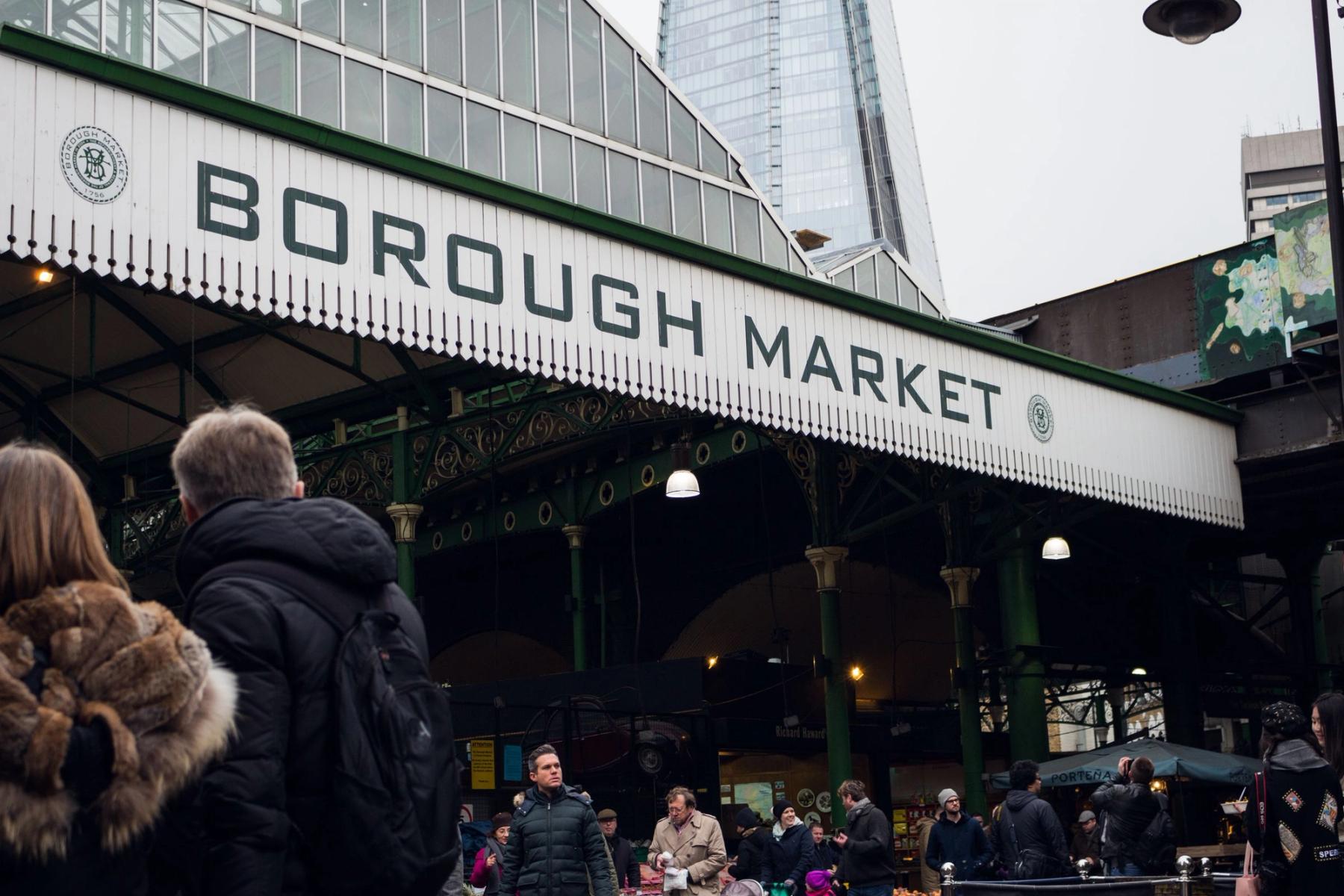
Editor’s note: The people and dialogue in this city scene are editorial reconstructions composed from documented urban conditions; the photograph is independently credited.
At seven in the morning, Borough Market is not picturesque. A reversing van makes three attempts at a narrow turn. Crates of herbs darken the pavement with rain. Someone drags a shutter upward and the sound travels under the railway arches like an announcement nobody needs explained.
Peter, a porter in this scene, balances two boxes against his chest. “By eleven they photograph the bread,” he says. “At seven we have to make sure there is bread.” The sentence separates the market’s two economies: one built from labour, the other from attention.
A baker tears the end from a loaf that will never reach the counter and passes it across an alley. Steam lifts for a second. Trains cross above the roof, turning conversation into mime. London is often described through institutions; here it is measured in delivery windows and hands that know where everything belongs.
By nine, the signs are straight, the counters abundant and the first visitors uncertain where to look. The work retreats behind display. Peter has already moved to the next entrance, leaving no trace except the fact that the scene now appears effortless.
The railway is not background here. Every few minutes, a train crosses the viaduct and reminds the market that Southwark has always been a place of arrival before it was a destination. The arches hold refrigeration units, kitchens and stores; old transport infrastructure has been made to carry another kind of circulation. Food comes in by road, customers arrive by rail, and both movements meet beneath brick darkened by more than a century of weather.
At one counter, three generations use different vocabularies for the same cheese. The producer speaks about pasture and season; the buyer asks about margin and shelf life; a visitor wants to know what will survive a flight to Singapore. None of the questions is illegitimate. A market earns its seriousness by allowing provenance, commerce and pleasure to test one another in public.
The danger of a celebrated food market is that appetite becomes theatre and labour becomes scenery. Here, the correction arrives in practical details: the taped fingers of a fishmonger, a handwritten temperature log, the wet apron carried to a laundry bag. These are not romantic accessories. They are evidence that abundance has been assembled by people whose day began before the photograph.
Near the cathedral, an office worker buys one pear and eats it standing up. A chef rejects an entire tray of leaves with a glance. Two visitors divide a pastry using the blunt edge of a paper spoon. The market’s democratic promise is imperfect but tangible: expertise and impulse occupy the same aisle, and a transaction can still become a short lesson offered without condescension.
By lunchtime, Peter’s route is impossible to reconstruct. The alleys are dense, the counters immaculate, the smells edited into sequence. Yet the morning remains inside the display. Each aligned loaf and polished apple carries the invisible chronology of unloading, checking, trimming and refusal. Luxury, in this light, is not excess. It is work made coherent enough that another person can briefly understand it.
When the bells finally sound, nobody in the loading bay looks up. Ceremony belongs to the public hour; precision belongs to the people who prepared it. Borough Market contains both Londons at once, and becomes most persuasive where they touch without pretending to be the same.
Markets survive by changing what they sell and what the public believes a market is for. Borough’s modern reputation rests on specialist retail, but its longer economic logic was shaped by proximity: river, bridge, road and railway made Southwark a receiving point for food before refrigeration and logistics platforms altered the geography of supply. The contemporary visitor encounters heritage as atmosphere; the trader encounters it as rent, access, regulation and the obligation to convert perishable stock into income before time removes the margin.
That pressure complicates easy praise of authenticity. A producer’s story can justify a higher price, but storytelling also becomes unpaid labour added to cultivation, baking or curing. Customers increasingly want proof of origin and an encounter with the person behind the product. The request can reward skill; it can also turn a working life into a performance repeated hundreds of times a day. The most convincing traders refuse both anonymity and theatre. They explain enough to make judgement possible, then return attention to the food.
Tourism has not simply displaced local use. It has changed the hours, portions and visual grammar through which the market earns. Foods become portable, counters become backgrounds, and queues signal value before taste can. Yet office workers, cooks and residents continue to use the same aisles with different calculations. Their coexistence is economically productive and socially tense. The market must remain legible to a first-time visitor without becoming useless to the person buying lunch on a Tuesday.
This is why the unseen morning matters. It is the period in which claims are tested against matter. The fish is either cold enough, the fruit either sound enough, the delivery either present or absent. Branding cannot repair a missing crate. In those hours, Borough is less a picturesque quarter than a compact risk-management system operated through trust, inspection and memory. When the doors open, the public receives not raw abundance but thousands of decisions about what deserved to appear.
The first bell is therefore not the beginning of the market, only the moment when its private preparation becomes public. A city that wants attractive destinations must learn to value the hours before attraction: the worker who checks a temperature, the driver who waits for a gate and the person who makes a judgement no visitor will ever see. Their work gives the market its authority, and their absence would be noticed only when the display failed.
A market’s public image is usually built from the final ten minutes of its preparation: the polished counter, the warm loaf, the first customer tasting something that appears to have arrived by instinct. The real market is the preceding negotiation. A supplier calls to say a delivery is late. A trader decides whether to accept a smaller crate at the same price. A porter changes the order of work because a vehicle has blocked the bay. These decisions are economic journalism in miniature. They show how value is made before it is displayed.
Borough’s celebrated status has brought investment and attention, but attention can be double-edged. It raises the value of a place while encouraging visitors to consume the atmosphere of labour without learning its cost. The market has to make itself welcoming to people who arrive for an image and useful to people whose income depends on the next hour. That is not a branding problem. It is a question of whether a heritage district can remain a workplace after it becomes a destination.
Peter knows which stall is short of hands and which vendor will lend a trolley without asking. His knowledge is not recorded in the market guide, yet it is part of its infrastructure. If the people who hold that knowledge are priced out, the place may retain its name, façades and social-media appeal while losing the coordination that made it work. Continuity is not guaranteed by preservation alone. It is carried by people who can afford to keep returning.
When the first bell sounds, Peter finally eats. He chooses a damaged pear and stands beside the loading gate. Above him, a train crosses towards the City. The market now looks ready to receive the public, but Peter’s morning has already contained the whole argument about London: wealth travels through grand structures, and it becomes meaningful only when ordinary hands can give it a reliable form.
The market’s public value is not measured only by the number of visitors who can describe it afterwards. It is measured by whether a porter can still afford to work there, whether a small producer can negotiate a fair delivery, and whether a resident can buy an ordinary meal without having to participate in a spectacle. Heritage is useful when it protects the conditions of daily use rather than replacing them with a picture of use.
At nine, the first bell has already become background noise. A baker checks a message from home, a student buys fruit before a seminar, and a visitor asks which stall has been there longest. The question is less important than the answer’s tone. The market is not a museum of continuity; it is a place where continuity is negotiated shift by shift.
The market earns its name as a destination only when it remains useful as a place of work. That distinction matters to every stallholder who begins before the visitor arrives. Public history should record not only what a place sells, but the agreements, risks and forms of skill that allow it to open again tomorrow.
The market's morning begins far beyond Southwark. Before Peter lifts a box, somebody has checked a catch, graded fruit, loaded a refrigerated vehicle, mixed dough or negotiated a price that may leave little room for error. A display of abundance compresses those distances into a few metres of counter. Customers see colour, craftsmanship and choice; traders see shelf life, margins and the weather reports that altered a harvest. Food markets are often praised as an escape from impersonal supply chains, but they are not outside those chains. They make them briefly legible. A label, a conversation and the condition of a product can restore some of the knowledge that supermarkets remove, provided the romance of the stall does not conceal the pressures carried by producers and workers.
Peter's work is a form of spatial intelligence. He knows which doorway will be blocked at eight, which crate cannot sit beside a heater, which trolley wheel catches on an uneven stone and which trader will need help before asking. None of this knowledge appears in the market map. It exists in muscle memory and in the informal exchange of warnings. Cities depend heavily on expertise of this kind, accumulated through repetition but rarely granted the prestige of a formal plan. When redevelopment or regulation changes a working environment, the loss is not measured only in jobs. It can erase a practical archive held by people who understand how the place behaves under pressure.
By midmorning, Borough is interpreted through appetite. Visitors arrive with recommendations, saved videos and lists of things that must be tasted before a train. Their enthusiasm is not false. Markets matter because food allows strangers to approach a city through pleasure rather than instruction. Yet attention changes the object it celebrates. A stall that becomes famous may face longer queues, higher expectations, greater waste and a clientele less interested in ordinary provision than in a singular experience. Traders must decide whether to serve the neighbourhood, the destination economy or both. Success is not a neutral reward. It changes hours, menus, rents and the kinds of risk a small business is expected to carry.
The baker in the reconstructed scene has been awake since a time that still belongs to the previous night. Flour on an apron photographs beautifully, but fatigue does not. The public language of artisan food often emphasises passion because passion makes long labour sound voluntary. Skill deserves admiration, but admiration should sharpen rather than soften questions about pay, predictable schedules and the ability to remain in a craft without sacrificing health. The difference between a tradition and an aesthetic is whether the people who hold the knowledge can build a life around it. A city cannot preserve the appearance of workmanship while treating workers as replaceable.
Under the railway, every conversation is periodically overruled by a train. The interruption is part of the market's identity and a reminder that this district is defined by overlapping infrastructures. Commuters pass above food deliveries; hospital workers cross tourist routes; residents navigate a place advertised to the world. Borough's vitality comes from proximity, but proximity also distributes inconvenience unevenly. Noise, refuse, crowding and late-night movement are experienced differently by a visitor who stays for an hour and a tenant who must sleep before an early shift. Good urban management does not resolve this by choosing authenticity over tourism or commerce over residence. It establishes limits that permit each use to remain credible.
A young cook named Amira enters the essay's reconstructed morning carrying a notebook stained at the corners. She is comparing suppliers for a small café that has not yet opened. At one stall she asks about price; at another, consistency; at a third, whether an ingredient will still be available in winter. The questions turn shopping into planning. A menu is not merely a set of tastes. It is a forecast about labour, demand, transport and what customers will pay. When Amira chooses a less fashionable vegetable because the supply is dependable, she performs the kind of judgement on which independent hospitality survives. Innovation in food often looks dramatic on the plate and conservative in the spreadsheet.
London's food culture draws authority from migration, though the city does not always distribute recognition fairly. Techniques and flavours that entered through households, community shops and workers' cafés may later be repackaged as discoveries once they reach a prestigious counter. The market can either repeat this extraction or correct it by naming origins, crediting knowledge and allowing businesses rooted in those traditions to participate on viable terms. Representation is not achieved by displaying a global pantry. It requires attention to who owns the stall, who writes the description, who is called an expert and who receives the durable value created by public enthusiasm.
There is also a class question in the transformation of food into culture. Exceptional ingredients cost what their production demands, and unrealistically cheap food often hides exploitation. At the same time, a market that offers only premium experiences ceases to perform the ordinary civic function of feeding nearby people. The tension cannot be solved by asking individual traders to absorb every cost. It involves rents, business rates, procurement, transport and the availability of modest meals. A serious market should be able to support celebration without making daily nourishment feel like an inferior use of space. The measure of abundance is not how many rare products can be photographed, but how many kinds of customer can eat with dignity.
Near closing time, the visual economy reverses. Perfect piles are broken, crumbs accumulate, and unsold food becomes an ethical and financial question. Traders discount, donate, preserve or discard according to what is safe and possible. Waste is easy to condemn from a distance, but perishable commerce runs on uncertainty. Demand changes with weather, transport failures, online attention and events nobody predicted when an order was placed. Reducing waste requires information and coordination as much as good intentions: storage, collection, flexible menus and buyers willing to accept that abundance need not mean every item is available until the last minute.
Peter's body registers the market in a way no visitor map can. By noon, the weight of the boxes has moved into his shoulders. Repetition produces competence and wear at the same time. Urban economies often celebrate workers for their resilience when what they need is equipment, staffing and time. The porter who can carry an awkward load should not be required to prove that skill until injury. Respect for labour becomes meaningful through design: clear routes, maintained surfaces, realistic delivery slots and a culture in which asking for assistance is treated as professionalism rather than weakness. Beauty at the counter begins with safety behind it.
The market's history is long enough to tempt easy claims of continuity. But continuity in London is usually a series of relocations, regulations, fires, closures, reinventions and acts of collective defence. What persists is not an untouched format. It is a public expectation that this part of the city will remain a place of exchange. That expectation carries obligations. Heritage cannot mean freezing a curated image at the moment it became attractive to affluent visitors. It must leave room for unfamiliar businesses, changing diets and new forms of work. Otherwise preservation becomes a method of excluding the future while selling the atmosphere of the past.
Amira returns to the first stall because the supplier answered a question without pretending certainty. A crop may be late; a price may move; an alternative can be planned. Trust in commerce is not the promise that nothing will change. It is the willingness to make change discussable before it becomes somebody else's emergency. This is why the market conversation matters. Digital ordering can be efficient, but a relationship allows two businesses to share information that a transaction form cannot value: the kitchen's limitations, the farm's conditions, the customer's habits and the point at which substitution becomes dishonesty.
When the lunch crowd thickens, Peter is almost invisible. He eats the torn end of bread while standing beside stacked crates, then returns to work before the public notices the pause. The scene risks sentimentalising him, so it is important to be precise: invisibility is not noble. The city benefits when skilled labour is seen, paid and given routes into security. The objective is not to preserve a picturesque hierarchy in which some people arrange abundance for others. It is to make the system sufficiently fair that the porter, baker, trader and customer can each imagine remaining part of it.
In the afternoon, Amira writes a provisional menu on the train. Three ingredients have changed, but the logic has strengthened. She has learned which products carry a story and which carry a relationship. A story can sell once; a relationship helps a kitchen survive a difficult month. Borough's authority lies in the possibility of both. Its public theatre draws people close enough to care about food, while its working intelligence connects care to supply. The market fails when the theatre consumes the work. It succeeds when attention is returned, in some form, to the people and places that produced what is admired.
The first bell of the title is not a literal sound but a threshold. Before it, the market is logistics; after it, the same arrangements become hospitality. Peter crosses that threshold without ceremony. He straightens a sign that is not his responsibility, moves a crate out of a wheelchair route and answers a lost visitor with directions precise enough to include the easiest crossing. These acts do not appear on a receipt. They are part of the civic surplus produced by people who know a place well. A market is more than a collection of businesses when such knowledge is allowed to accumulate and when the institution recognises its value.
The next morning, abundance will be assembled again from imperfect information and physical work. Bread will cool, herbs will darken the pavement, and trains will interrupt instructions. Visitors may believe they have discovered the market at the moment it becomes photogenic. Peter knows discovery happened hours earlier, when a missing order was replaced, a damaged box was noticed and somebody made room for another trolley in a narrow passage. The lasting image is not the finished counter. It is the quiet transfer of a warm piece of bread between two workers who understand that appetite begins as responsibility before it becomes pleasure.
The market's relationship to the surrounding borough makes this responsibility concrete. Nearby residents do not experience Borough only as an international destination. They need affordable shops, passable pavements, employment that offers progression and institutions that listen when success imposes costs. A market can use its visibility to strengthen the local food economy through training, procurement and support for smaller producers. It can also become an enclave whose language of community bears little relation to who can trade or eat there. The difference is found in lease terms, recruitment and everyday decisions about space, not in heritage copy.
Amira's café eventually opens with twelve seats and a menu that changes more often than she intended. The first months are not a montage of appreciative customers. They include a failed refrigerator, an illness that removes half the kitchen and a week in which rain suppresses trade. The supplier relationship formed at Borough does not eliminate these problems, but it gives her somebody to call before altering the menu. Resilience in small business is frequently described as personal courage. More often it is a network of people prepared to share warning, flexibility and knowledge before a shock becomes insolvency.
Peter visits once on a day off and chooses the cheapest thing on the menu. Amira recognises him only after he explains where they met. Their conversation is brief because the lunch queue has formed. He does not need to become a mentor or a symbol of the market's generosity. His presence completes a modest circuit: labour that prepared one commercial scene enters another as a customer. The dignity of a local economy is visible when workers are not confined permanently to the service side of the counter.
Food carries memory with unusual speed, but memory should not be used to make exploitation feel wholesome. The loaf passed in the alley matters because it is warm, because two workers pause and because skill has produced something worth sharing. Its emotional force increases when the conditions behind it are examined rather than idealised. London earns its reputation as a food city when pleasure leads backwards towards responsibility: to fields, boats, kitchens, vehicles and hands, and then forward towards wages, access and the possibility that those hands will still be practising the craft years from now.
Before opening on a winter morning, Amira visits the market carrying two empty crates. She no longer needs Peter's directions but still notices the route he kept clear. A new porter is working the entrance, and for a moment the continuity appears effortless. It is not. It consists of another person learning weights, names, surfaces and the point at which help should be offered. The market's public reputation will be renewed later by photographs and reviews. Its deeper record is transferred now, in the practical language of where to stand and how to carry something valuable without damaging either the goods or the body. That is the inheritance worth protecting: not abundance as a scene, but competence made sustainable enough to pass on.
The same standard should govern editorial attention. To photograph a counter is easy; to follow the ingredient backwards and the worker home is harder. The fuller account may be less flattering, but it makes pleasure more durable by connecting it to choices that can improve. Borough Market deserves serious writing not because every transaction is exemplary, but because its compressed geography allows the city to see how taste, migration, land, labour and public space meet. What London eats is also a record of whom it rewards, what it remembers and which forms of work it permits to have a future.
The market’s luxury is not rarity alone. It is the concentration of skill made visible for a few public hours, supported by a longer morning that most visitors never see.