

Editor’s note: The dialogue in this terminal scene is an editorial reconstruction.
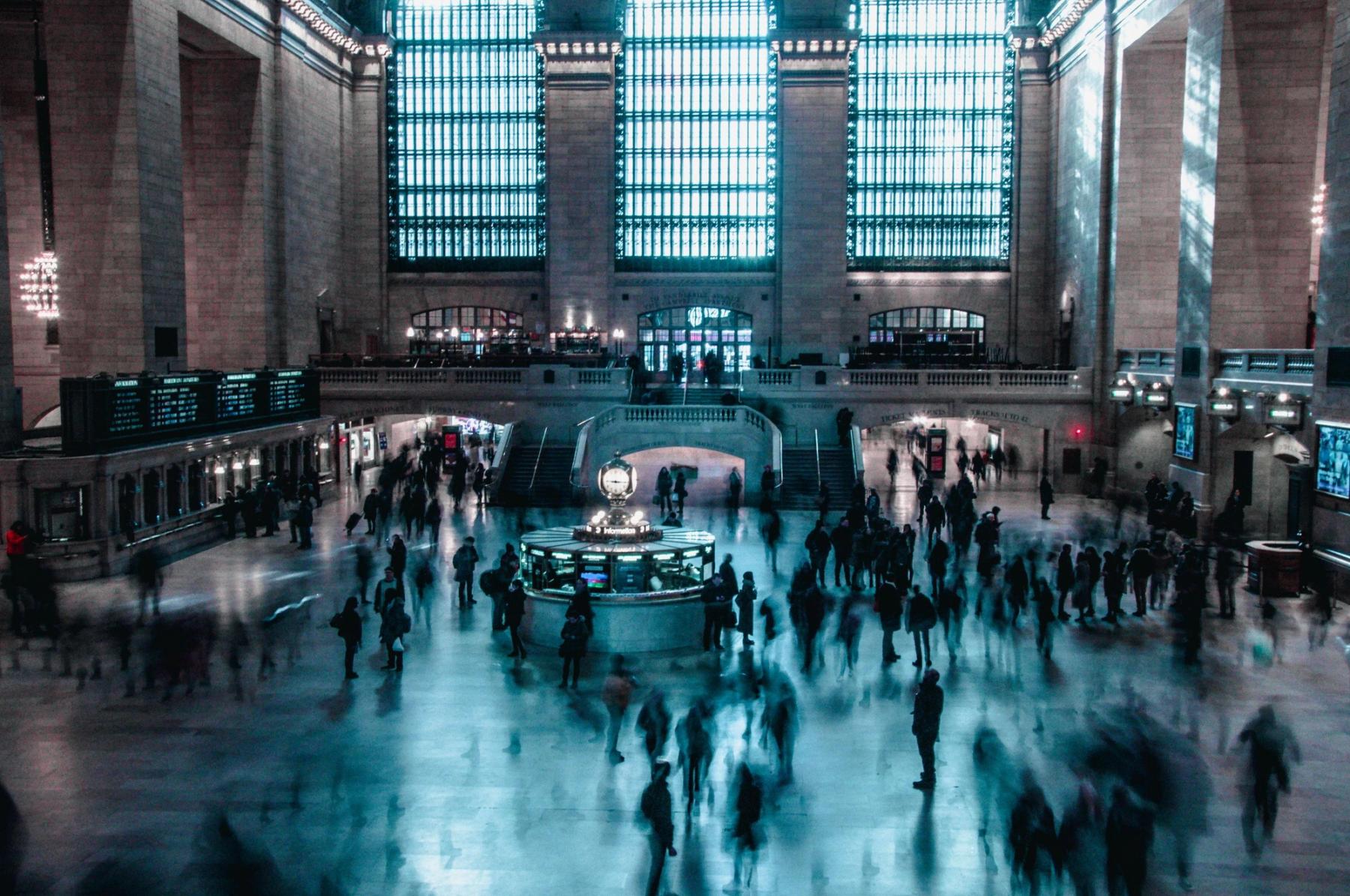
At the end of the working day, Grand Central gathers speed beneath a ceiling painted to suggest stillness. Shoes strike stone, destination boards change and the clock at the centre becomes a place people orbit rather than consult.
Daniel has come early to meet his daughter’s train in the imagined scene. He refuses to check the platform twice. “A proper welcome requires a little waiting,” he says, holding a paper bag from a bakery in Queens.
Around him, reunions begin and end in seconds. A hand rises above the crowd. A suitcase tips. Two colleagues finish a disagreement while walking in opposite directions.
The terminal turns logistics into civic theatre because everyone understands the plot: someone is leaving, someone is late, someone has chosen to be present at arrival.
Terminals are built around certainty and filled with doubt. Tracks have numbers, trains have times, yet the human purposes attached to them remain unstable. A delayed arrival may be an inconvenience, a reprieve or the last hour before a family changes shape. The board can measure minutes but not their weight.
Daniel’s paper bag contains two black-and-white cookies, a joke from his daughter’s childhood that has survived her years away. He has rehearsed a casual greeting because ceremony embarrasses them both. Around the clock, other people conduct the same private preparation: flowers rearranged, jackets fastened, difficult news temporarily postponed.
The concourse makes waiting visible. In a restaurant or office, stillness must be explained; here it is an accepted purpose. People stand beneath the celestial ceiling with nothing to do but remain available for another person’s arrival. This may be the terminal’s most generous civic function.
A cleaner steers around reunions without interrupting them. Police watch the entrances. Commuters cross diagonally through groups that have stopped. The celebrated room is also a workplace and a controlled space, its romance dependent on labour, surveillance and the reliable clearing of what yesterday left behind.
When the daughter appears, she is older than the image Daniel carried to the station and immediately familiar in motion. Their embrace damages the cookies and ends the elaborate waiting. The terminal’s scale does not diminish the moment; it prevents it from needing to perform for anyone else.
Minutes later, the clock has another set of people beneath it. Grand Central preserves no trace of who met whom. Its permanence lies in making room for repetition, allowing thousands of private histories to borrow the same magnificent address and leave it intact for the next arrival.
Grand Central emerged from the demands and dangers of rail at metropolitan scale. Its architecture separated flows, placed tracks below the city and made circulation itself monumental. The terminal’s celebrated surfaces can obscure the corporate power and engineering behind them, but the building is persuasive precisely because those systems were translated into rooms a traveller can understand: ramp, clock, concourse, gate.
The terminal has also survived changes in the value assigned to urban land and rail travel. There were periods when demolition appeared more profitable than preservation. Its endurance therefore cannot be credited to stone alone. It depended on legal protection, public advocacy and a changing judgement about whether a city should measure value only by what a site could be replaced with. Preservation was an economic decision about identity as much as an aesthetic one.
For commuters, the romance is disciplined by repetition. The same ceiling that astonishes a visitor may become a weatherproof shortcut between train and office. This familiarity is not a failure of appreciation. It is the highest form of urban usefulness: beauty absorbed into routine without being exhausted by it. Daniel’s waiting borrows grandeur, but the building does not require him to acknowledge the loan.
Arrival has a particular importance in New York, a city narrated through migration. Not every train crosses a national border, yet each delivers people into altered circumstances: a first job, a return after illness, a weekly division between home and work. The terminal gives these transitions an architecture without claiming to know their meaning. Its clock coordinates bodies; the stories begin when people recognise one another beneath it.
A terminal’s lasting dignity is measured by the welcome it can hold for people who arrive without ceremony. Daniel’s daughter does not enter as a symbol of New York, and he is not a representative of family life. They are two people carrying private time into a public building. The city’s great rooms matter because they do not require private feeling to become grand before they give it shelter.
The terminal’s public meaning is therefore inseparable from its private use. Its ceiling survives as a landmark, but its real archive is made of meetings that leave no plaque: a worker met after a night shift, a child collected from a bus, a parent welcomed home. Grand Central gives these moments no official history. It gives them something more generous, a room that can receive them without asking whether they are important enough.
Grand Central was designed to make a complex transport system intelligible. Tracks descended, platforms were organised and the concourse gave travellers a visible centre. This was engineering translated into civic form. The terminal’s beauty matters because it teaches people how to move through a system larger than themselves. It turns coordination into a room where direction, waiting and arrival can be understood without a private guide.
That public clarity has always depended on hidden labour: signalling, cleaning, scheduling, maintenance, policing and the management of crowds. The terminal is romantic at blue hour because people can forget the machinery supporting the scene. The workers cannot forget it. Their expertise keeps private reunions from becoming public disorder and allows the building to appear calm while thousands of decisions pass through it.
Daniel’s welcome carries another history. New York is continually described through arrival, yet the word can conceal the uneven conditions under which people enter the city. Some arrive with a reservation, a position and a family waiting; others arrive with a bag, a temporary address and a job that begins before dawn. The terminal does not make these circumstances equal, but its public room can acknowledge that every arrival is a claim on the city’s capacity to receive.
When the daughter reaches him, neither speaks about the building. That is the point. Architecture has made itself useful by giving the moment a stable setting and then withdrawing. The greatest public rooms do not demand that private life perform gratitude. They hold the encounter, let it matter, and remain available for the next person whose history will briefly pass beneath the clock.
Grand Central’s theatre depends on a less theatrical system of maintenance. Clocks must agree, stairs must be repaired, and the floor must withstand a procession that never becomes a single crowd. The station’s beauty is therefore inseparable from administration. Architecture offers the promise of order; staff and infrastructure make that promise credible every minute of the day.
The traveller who waits beneath the painted sky may feel outside the city, but the station is where the city becomes most visible: service workers changing shifts, families negotiating luggage, commuters reading the same delay board with different stakes. Departure is never only movement towards elsewhere. It is an encounter with the institutions that decide whether movement will be possible.
Waiting is not empty time when a city gives it an institution. In Grand Central, uncertainty is gathered into a room where people can read, ask and orient themselves. The terminal’s lasting beauty comes from making millions of private departures legible as one public rhythm.
Grand Central is often photographed as an emblem of arrival, but its deeper civic function is to organise uncertainty. The board changes, the platform shifts and the traveller waits, yet information remains shared. This common visibility matters. It prevents every delay from becoming a private mystery and gives people a chance to adapt together. The terminal’s architecture does not promise that journeys will be smooth. It gives disruption a public setting in which staff, families, commuters and visitors can negotiate what happens next. A child looking up at the painted sky may not know the history of the building, but she understands its emotional purpose. Waiting can be made larger than frustration. A city becomes humane not when it eliminates dependence, but when it gives dependence dignity.
The station’s architecture gives waiting a common vocabulary. People look at the same clock, read the same board and listen for the same announcement. This does not erase unequal stakes, but it keeps uncertainty from becoming entirely private. A public institution can be beautiful precisely because it gives ordinary difficulty a place where it is acknowledged rather than hidden.
The station teaches this without explaining it. Its authority comes from making shared uncertainty visible, and from giving people enough beauty to remember that waiting is still part of a life, not a failure of planning.
Grand Central's authority begins with an inversion. A building devoted to movement creates one of the city's most convincing experiences of permanence. The trains are hidden below, schedules change and crowds replace themselves, while stone, clock and painted ceiling suggest that arrival has been given a stable civic room. This is more than decoration applied to transport. It is an argument that routine movement deserves architecture capable of holding memory. A commute repeated thousands of times may contain grief, ambition, boredom and reunion. The terminal gives those private variations a shared scale without needing to know their names.
Daniel arrives early because punctuality is one of the few forms of care he trusts himself to perform without explanation. His daughter, Maya, has been away at university and is returning after deciding not to complete the term. The paper bag contains pastries she liked as a child, an offering that belongs to a simpler script of welcome. He does not yet know whether to ask what happened in the station, in the taxi or not at all. Waiting becomes emotional preparation disguised as logistics.
Rail terminals organise separation as much as connection. The suburban network made it possible for households and businesses to spread across a metropolitan region, redistributing land value, opportunity and political identity. It also established daily dependence between jurisdictions that may govern themselves separately while relying on one another's workers and institutions. The person stepping off a train carries the consequences of housing policy, school systems, taxes and service levels from another place into Manhattan. A terminal is therefore a border without customs, crossed through schedules rather than passports.
The famous clock at the information booth functions less as a precise instrument than as a point of agreement. People say they will meet beneath it because architecture can resolve the uncertainty of a crowd. In the era of location sharing, this may seem unnecessary, yet digital precision does not eliminate the need for legible public landmarks. A phone can indicate that someone is near; the clock creates a place where being near becomes being found. Civic space is made from such conventions, repeated until strangers can coordinate without private ownership of the setting.
The terminal itself survived a period when many American railway buildings were treated as obsolete land rather than public inheritance. Preservation was not an automatic victory of taste. It involved legal argument, political pressure and a changing understanding that property rights in a consequential urban site coexist with public interest. The lesson is not that every old building must remain unchanged. It is that demolition is an irreversible decision and that the value of an institution may exceed the income measurable on its footprint.
This history shadows the beauty. Visitors looking upward at the constellations participate in a culture that now assumes the room was destined to survive. Nothing in a city is destined to survive. Buildings endure because maintenance is funded, uses remain viable, regulations hold and enough people continue to argue that the place carries meaning. Heritage is not an adjective possessed by stone. It is a relationship renewed by institutions and publics, often after years in which neglect made loss appear reasonable.
Daniel watches workers reset a retail display while a tour group photographs the ceiling. Commerce is embedded in the terminal because transport generates attention and attention produces rent. Shops provide services and revenue, but the building must remain more than a mall with trains below. Its fundamental promise is passage. A person rushing for a platform should not be treated as an inconvenience to the commercial scene, and a person waiting without purchasing should retain the right to occupy the public drama. Balance is achieved through daily management rather than a slogan.
Maya's train is delayed outside the terminal. The board revises the expected time by small increments, each one preserving hope that the previous estimate was nearly right. Daniel resists calling. He remembers picking her up from school on a day she had been humiliated by a teacher and asked no questions until she spoke. Parenthood, he thinks, may be another form of waiting beside an unreliable board: remain present, do not pretend to know the arrival time, and be prepared for the destination to have changed.
Around him, commuters move with the economy of people who have rehearsed the route. They know which side of a staircase accelerates, which carriage aligns with an exit and how much time can be recovered between clock and platform. This expertise is rarely celebrated because it serves repetition rather than novelty. Yet it represents hours of life. A reliable terminal respects that accumulated knowledge by keeping routes clear and information consistent. A redesign that confuses experienced users in pursuit of visual freshness spends a resource the institution did not create alone.
Accessibility complicates the terminal's monumental image. Elevators, ramps, readable signs, audible announcements and places to rest determine whether grandeur can be inhabited by different bodies. Historic buildings are sometimes defended as though inclusion were an aesthetic intrusion. The more serious view is that public relevance requires adaptation. Preservation worthy of the future does not protect an old hierarchy of access. It asks how the identity of a place can remain legible while its welcome becomes more complete.
A station agent answers the same platform question three times in a minute. Repetition is part of the work, but no answer is entirely routine to the person asking. One passenger is calm, another has missed a connection, and a third is trying to reach a hospital. Institutional dignity is produced at this human interface where policy and anxiety meet. Technology can distribute information widely; staff recognise when information has failed to become understanding. Their presence is not evidence of an outdated system. It is an acknowledgement that consequential journeys sometimes require interpretation.
Grand Central also contains hidden economies of time. A commuter who travels ninety minutes each way gives the metropolitan region a portion of life not counted as paid work. Some use the train to read or answer messages; others stand, care for children or recover from physical labour. Remote work changed these calculations for part of the workforce but not for those whose jobs require presence. Transport debates that assume everyone can choose when to travel risk designing around professional privilege. A common network must begin with the people who have the least control over the hour.
Daniel opens the bag to check whether the pastries have survived. One has lost its shape. He closes it before anybody can see his disappointment. The gesture contains the temptation to make welcome perfect, as if a flawless object could protect Maya from the conversation ahead. The terminal offers a corrective. Every arrival here is mixed with delay, fatigue and the residue of elsewhere. Hospitality is not the presentation of an untouched scene. It is the decision to receive someone in the condition in which the journey has delivered them.
The ceiling's painted sky is famously detached from the actual weather. Below it, travellers inhabit a climate of architecture: constant light, controlled temperature, no rain. Such interiors can provide refuge, but they also make the energy and labour sustaining comfort easy to forget. The future of monumental public buildings will involve difficult work on efficiency, resilience and materials. The objective should not be to preserve twentieth-century consumption in the name of heritage. It should be to let future generations inherit both the room and an institution capable of operating it responsibly.
Maya appears before the board has updated. Daniel recognises her coat, then her uncertain pace. The embrace crushes the paper bag exactly as the earlier scene records. For several seconds, the terminal's scale disappears. This is often described as architecture framing private emotion, but the relationship works both ways. Repeated private moments give architecture public meaning. A hall becomes beloved because countless people have attached departures, apologies and returns to its surfaces. Preservation protects not only design but the accumulated right to make new memories there.
They sit on a bench rather than leaving immediately. Maya says she could not keep pretending that the course was hers. Daniel's first response is a practical question about housing, and he hears its inadequacy as soon as it is spoken. The station permits a pause between arrival and the next decision. Around them, people continue towards platforms with destinations already printed. Their stillness is not failure. It is the necessary interval in which a route can be reconsidered before another ticket is bought.
A terminal is particularly suited to this uncertainty because it never confuses movement with progress. Trains can carry people home, towards work, away from responsibility or into a mistake. The network supplies direction, not purpose. Modern culture often borrows the language of journeys to imply that every change leads towards a coherent self. Grand Central is wiser. Its tracks run both ways. Return is not the opposite of ambition, and departure is not proof of courage. Meaning is made through the reasons people travel and the conditions in which they are received.
Daniel and Maya divide the damaged pastries on the train north. The paper bag, which seemed a poor substitute for conversation, becomes useful after all. Outside, tunnels yield to brief views of streets and then to the wider metropolitan edge. Their discussion remains unfinished, but it has moved from crisis towards possibility. The terminal did not solve it. Architecture seldom deserves that much credit. It provided a room large enough for uncertainty not to feel like private disgrace and a route on which two people could begin speaking side by side rather than face to face.
At blue hour the following day, another person waits beneath the clock with a different bag and a rehearsed sentence that may never be used. The board changes; the platforms receive and release their crowds. Grand Central endures not by resisting this replacement but by giving it form. Its permanence is made from departures. Its grandeur is justified when the ordinary traveller, including the late, tired and uncertain, can still find information, shelter and a place to be recognised. The building's deepest theatre is not spectacle. It is the repeated public assurance that an arrival, however complicated, will have somewhere to occur.
The terminal's preservation also shaped the legal imagination of the city. It affirmed that ownership does not exhaust the meaning of a landmark whose loss would alter public life. Such protections can impose real costs and must be administered fairly, but they express a principle essential to any civilisation that claims a future: some decisions must account for people who are not yet present to object. A city thinking only in immediate returns will inherit no room in which later generations can recognise its judgement.
Maya's interrupted education resists the terminal's seductive narrative of destinations. Institutions often require young people to state a plan before they have encountered enough life to choose one honestly. Changing course can carry debt, shame and practical difficulty, but persistence in the wrong direction is not automatically courage. Daniel's task is to distinguish support from control. The station's multiple tracks offer no answer; they simply make visible that a network can hold more than one valid route.
Commuter rail also determines who can participate in the cultural and economic life concentrated around the terminal. Fare levels, service outside peak hours and connections at the suburban end affect workers, students and families differently. A train designed chiefly around the traditional office commute may fail the nurse returning late, the restaurant worker travelling on a weekend or the parent making a midday appointment. Metropolitan belonging requires a timetable that recognises more than one model of work.
The damaged pastry becomes a family joke rather than a symbol they discuss. Months later, Maya sends Daniel a photograph from a community college classroom. She has chosen a different field and still does not know whether it will last. He replies with the train time for her next visit. Care returns to logistics, but now the practical message carries a better kind of restraint. It says there will be a platform, a clock and somebody waiting, without demanding that uncertainty be resolved before she comes home.
Grand Central's most enduring promise is not that every arrival will be triumphant. It is that arrival remains a public category worthy of order and beauty. The exhausted worker, the student changing direction and the family carrying an imperfect welcome all enter the same room. The institution does not ask them to justify the importance of the moment. It provides signs, shelter, routes and a place of recognition. In a century of increasingly private and frictionless transactions, that common stage is not a nostalgic luxury. It is infrastructure for the human fact that journeys end in the presence of other people.
The next century will alter the trains, the climate demands placed on the building and perhaps the habits that now define commuting. Grand Central will remain valuable only if preservation allows it to answer those changes. The clock cannot become an excuse to stop civic time. Its purpose is to help people meet within it. Daniel and Maya's arrival belongs beside millions of others precisely because the room is not theirs. The terminal lends permanence to a moment, then returns the space to the public. In that exchange lies the mature meaning of a landmark: a structure protected long enough that strangers can continue using it to recognise one another.
Beauty strengthens this institution when it does not become a substitute for service. A painted sky cannot compensate for an unreadable sign, an inaccessible route or a cancellation explained too late. When operation and architecture support one another, however, the terminal offers something rare: practical competence with emotional range. It gets a passenger to a platform and gives the journey a place in memory. That combination is why the hall remains more than a backdrop. It is a working civic promise, renewed each time information becomes arrival and waiting becomes welcome.
When Daniel’s daughter appears, the paper bag is crushed in the embrace. The building’s grandeur recedes. Architecture has done its work by giving a private moment a memorable room.