

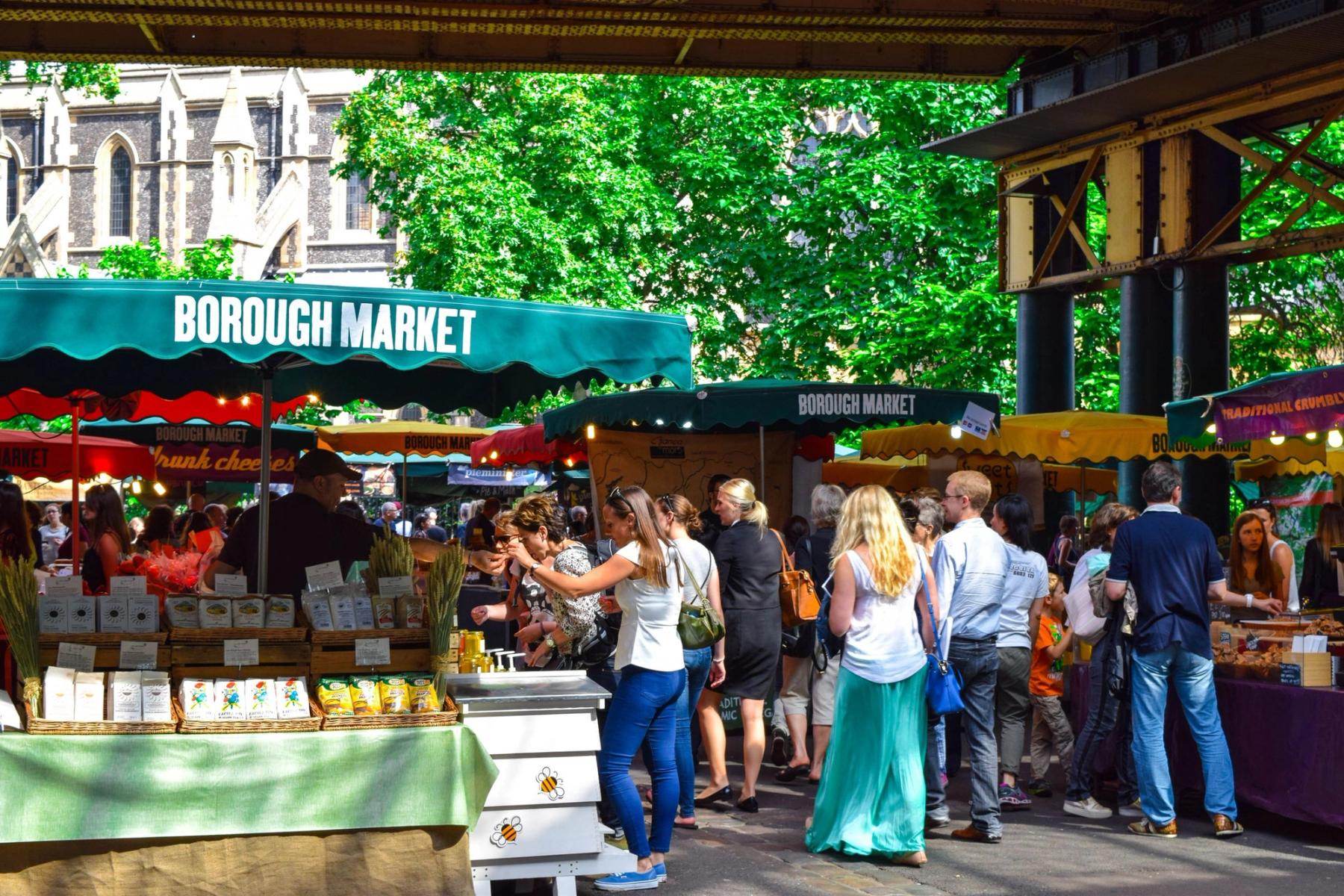
Editor’s note: The passer-by and dialogue in this city scene are editorial reconstructions rather than reported testimony.
Rain has not started, but London has prepared for it. Umbrellas appear beneath arms; newspapers fold into smaller shapes. At the crossing, twelve people lean forward before the signal changes, each performing impatience at a different angle.
A woman carrying tulips waits after everyone else has moved. “The quickest route is rarely the driest,” she says in the imagined exchange, choosing the covered market instead of the bridge. Her decision is minor and completely urban: weather edits the city one turn at a time.
The crowd divides around a delivery bicycle, reunites at a coffee window and divides again beneath the arches. Nothing has been choreographed, yet the pavement produces order from negotiation. Courtesy here is less a sentiment than a sequence of half-steps.
When the rain finally comes, it is too fine to justify the preparations. The umbrellas open anyway. The woman with tulips disappears among them, a flash of yellow moving south.
The street is a poor place for certainty. A map can name the corner but cannot describe the force of wind around it, the delivery van blocking half a lane or the school group occupying the shelter. Pedestrians make hundreds of adjustments that no plan records. The intelligence of walking lies in this constant revision, a civic competence so common that it is mistaken for instinct.
Under the market roof, the woman with tulips pauses beside a man arranging second-hand books. He places a sheet of plastic over the poetry first. History and biography are left to the finer rain. The choice is practical, perhaps accidental, yet it makes a small hierarchy of what the city believes must be protected immediately.
London’s reputation for reserve can look different at a crossing. Strangers signal with eyebrows, hold a door with one hand and decline thanks before it is fully spoken. The language is economical because the negotiation is continuous. Too much ceremony would stop the pavement. Too little would make it uninhabitable.
A child jumps into a gutter that every adult has stepped around. Water reaches the cuffs of two tailored trousers. For several seconds, annoyance competes with admiration. The child has misunderstood the street as play and, in doing so, revealed how thoroughly the adults have accepted it as transit.
The tulips travel beneath the arches, past a queue, then into a bus whose windows have begun to mist. Their destination is never disclosed. That absence matters. A city is not only the sum of stories completed in public; it is also the great traffic of purposes that remain private while sharing the same route.
By evening the pavement will dry unevenly, preserving darker patches beneath benches and awnings. The weather leaves an unofficial map of shelter. Tomorrow’s pedestrians will cross over it without seeing the decisions that made today’s passage possible.
Walking is often described as the absence of transport spending, which misses its economic force. A pedestrian notices the shop one street over, changes route without a timetable and can enter a transaction without first storing a vehicle. London’s official planning language increasingly treats public realm, legibility and accessibility as infrastructure because the pavement influences health, trade and belonging at once. The woman’s choice of shelter is personal; multiplied by millions of journeys, such choices decide which streets remain commercially alive.
The distribution of comfort is not neutral. A covered arcade, a bench, a public toilet and a crossing long enough for an older person to complete are forms of wealth. Their absence transfers cost onto the body: more fatigue, more risk, fewer journeys attempted. People with money can buy shelter in cafés or choose a car. Everyone else depends more directly on whether the city has designed waiting as a legitimate activity rather than a failure to keep moving.
In 2023, official London reporting estimated millions of daily walking trips, while surveys continued to find residents who would walk more if routes gave pedestrians greater priority. The political argument is therefore not whether Londoners walk. They already do. It is whether the city treats their movement with the same seriousness accorded to faster systems. A chipped kerb or blocked footway looks trivial from a strategic map and decisive from a wheelchair, a delivery trolley or a tired knee.
Weather exposes this hierarchy quickly. Rain turns polished stone, narrows usable pavement and rewards those who know the covered route. The child in the gutter is free because an adult is nearby; the courier cannot avoid the puddle without losing seconds; the flower carrier can choose beauty over speed only because her destination allows it. One crossing contains several economies of time, and London’s civility is measured by whether the slowest person can complete it without apology.
The flower carrier reaches her destination with the stems intact and the tulips opening. Her route was not the city’s shortest, but it was the one that kept a small promise: that movement might include attention. In a metropolis measured by minutes, this is not an escape from economics. It is a reminder that the value of a street includes what it allows people to notice while they are using it.
A city that designs for walking is not merely making travel pleasant. It is deciding whose presence counts as part of the economy. The person who pauses to read a poster, buys from a small shop or walks a child to school contributes to a street’s life without entering it as a vehicle or a transaction. The flower carrier’s longer route makes that contribution visible. London’s most durable public realm will be the one that treats such unhurried presence as infrastructure rather than inefficiency.
The pavement is often treated as the leftover space between buildings and transport. In practice it is where the city’s promises are tested. A policy can announce inclusion, but a blocked kerb decides whether a wheelchair can cross. A plan can encourage walking, but a crossing interval decides whether an older person has to hurry. A retail strategy can praise footfall, but a narrow route decides whether a parent can stop to look at a shop window. The smallest surfaces carry the largest claims.
The flower carrier’s detour passes a book stall whose owner is measuring the awning. He says the rain has made the paper curl and that the market will be slow. She buys a used travel guide anyway, not because she needs it but because a street is partly sustained by the small decisions people make when they are not moving as efficiently as possible. Commerce is not separate from public life; it is one of the ways public life becomes visible.
London’s walkability debate also concerns who is allowed to be tired. A city designed around speed turns fatigue into private failure. A city with benches, shade, clear crossings and public toilets treats the body as a permanent citizen rather than a temporary obstacle. This is why access design is not a niche concern. It is a statement about whether everyone is expected to move through public space on the terms of the fastest and strongest.
By night, the street dries in irregular shapes. Tomorrow’s walkers will not know where the puddles were, but the city will carry the consequences of today’s maintenance, design and neglect. A good crossing disappears into confidence. The person who reaches the other side without thinking about danger is not experiencing less infrastructure; they are experiencing infrastructure that has finally done its work.
Crossing the Thames also reveals how infrastructure distributes dignity. A reliable bridge gives people time; a delayed bus charges them with uncertainty. The difference is felt most sharply by those whose work cannot be done remotely, whose shifts are unpaid when they arrive late, or whose care responsibilities leave no margin for another interruption. A crossing is therefore a small public promise that movement should not be a privilege of flexible schedules.
By the time the rain clears, the commuters have vanished into offices and schools. The bridge remains, but its meaning has changed with each body that used it. London is often described through destinations. Its deeper character lies in the arrangements that allow people with different destinations to share a route without having to know one another.
A crossing becomes part of a city’s moral infrastructure when it recognises different kinds of time. The commuter, the carer, the delivery rider and the visitor may use one bridge, but they do not carry the same margin for delay. Good public design does not make those differences disappear; it refuses to make the least protected person pay for them alone.
A city that values movement must also value the people who make movement possible. The bridge is an object, but the crossing is a social arrangement: signals are read, surfaces are repaired, routes are explained and strangers adjust their pace. On a wet evening, those arrangements become visible. The person with a flexible office can wait; the person finishing a care shift cannot. The public realm is fair only when it is designed for both. London’s historic crossings carry the memory of earlier engineering, but their future will be decided by the same practical question that made them necessary in the first place: can the city remain open to lives that do not move at the same speed?
A crossing is one of the smallest places in which a city declares its values. The declaration is made through kerb height, signal time, surface texture, visibility and the speed permitted to vehicles approaching the line. Most people experience these decisions as instinct: hurry, wait, step back, risk the gap. For somebody using a wheelchair, carrying a child, walking with limited sight or recovering from illness, the same geometry becomes explicit. A pavement can offer independence or quietly withdraw it. London contains crossings designed in different decades according to different assumptions about whose journey mattered. To read the city through them is to read a history of mobility translated into seconds.
The woman with tulips, called Helen in the reconstructed notes behind this essay, is not indecisive. She is calculating. A knee operation has made wet paving less forgiving, though nothing about her coat or pace asks strangers to recognise this. She watches the signal, the turning traffic and the sheen on a metal utility cover. Urban accessibility is often discussed through visible categories, but many pedestrians carry constraints that do not announce themselves. A well-designed crossing should not require a person to disclose vulnerability before granting enough time and grip to reach the other side. Dignity is infrastructure that works without an explanation.
London's irregular streets complicate the fantasy that a city can be solved through a single rational grid. Medieval routes, estate boundaries, rail lines, post-war roads and contemporary cycleways meet at angles inherited from different priorities. This produces charm from a map and uncertainty at ground level. The successful crossing is therefore not necessarily the most geometrically pure. It is the one that makes conflicting movements legible. People need to know where attention is expected, which signal governs them and whether a driver has enough information to anticipate their presence. Confusion transfers responsibility from design to the body least protected by it.
Weather intensifies every weakness. Paint becomes reflective, leaves conceal edges, umbrellas narrow peripheral vision and rain changes the distance in which a vehicle can stop. Londoners develop local knowledge about where water gathers and which underpass feels unsafe after dark. This practical climate map is rarely captured in promotional accounts of resilience. Yet adaptation begins with such observations. A flood strategy may involve major engineering, but daily resilience also means drains that are cleared, shelters placed where routes intersect, and maintenance teams able to correct a hazard before it becomes accepted as part of the neighbourhood.
At the next corner, a delivery rider waits with one foot on the road and one on the kerb. His timetable has been calculated by a platform that cannot feel the rain. The customer sees an estimated arrival; the rider sees a bus lane, a blocked loading bay and a surface on which sudden braking could end the shift. Digital systems have made movement measurable without making it equally controllable. When performance is judged to the minute, the uncertainty of the street is absorbed by the worker. A humane city must ask whether its appetite for convenience is being financed by risks that remain off the screen.
Helen enters the covered market and her route intersects with a parent pushing a buggy against the flow. Each moves half a step, apologises and continues. British accounts of public life sometimes treat this choreography as evidence of national politeness. The explanation is too flattering. Courtesy helps, but the encounter works because there is just enough space and because neither person is moving at a speed that makes correction impossible. Behaviour and design are partners. Appeals for civility cannot compensate indefinitely for narrow pavements, obstructed routes or junctions that force people into conflict.
The politics of crossing became painfully clear as London sought to reduce deaths and serious injuries on its roads. Targets and datasets are necessary because memory is selective; a collision that transforms a family can otherwise disappear into the scale of a metropolis. But numbers need interpretation. A junction may record few injuries because vulnerable people avoid it. A route may appear efficient because those who cannot manage it have stopped travelling. Safety should be measured not only by the absence of recorded harm, but by the presence of people who feel able to move independently.
Outside a pharmacy, an older man waits for the rain to settle. He is not part of Helen's story, but his stillness changes the pavement around him. People pass closer to the road, a courier dismounts, and a shop worker brings out a dry chair without discussion. This is the informal welfare state of the street: small accommodations offered because somebody notices. It can be moving, yet it should not become an excuse for institutional neglect. Kindness is most valuable when it supplements reliable provision, not when it is required to rescue people from preventable design failures.
Crossings also divide economic territory. One side of a road may offer offices, cultural institutions and clean public space; the other may hold cheaper housing but fewer services. A dangerous junction can turn physical proximity into practical distance. Parents choose schools according to whether a route feels manageable. Older residents reduce visits. Small shops lose passing trade from people unwilling to make the crossing. Transport planning is therefore also social and commercial policy. The placement of a refuge island or the length of a green phase can alter who participates in the life of a district.
Helen bought the tulips for a friend leaving hospital. The flowers create an absurdly delicate problem in the rain: one hand is occupied, the paper softens, and the safest route is longer. She chooses it. The detail matters because mobility is rarely an abstract journey from origin to destination. People carry groceries, grief, uniforms, instruments and children. They are late, distracted or newly uncertain in a familiar body. Design that assumes an alert, unencumbered adult moving at a standard pace describes almost nobody for an entire lifetime. A city for the future is one that anticipates variation as ordinary.
The signal near the hospital counts down. Some pedestrians speed up because the number appears to command them; others hesitate because it confirms they cannot complete the distance. Countdown technology offers information but also reveals the values embedded in timing. Who was used as the reference body? Was the interval tested in dry weather? Does a central refuge feel secure? These questions may seem technical until a person must make the choice under pressure. Then engineering becomes emotion: confidence, embarrassment, fear and the relief of reaching the opposite kerb without having been made into an obstruction.
London has learned to give certain public spaces ceremonial care while allowing ordinary connecting routes to remain abrasive. A museum entrance may be accessible, but the journey from the station is broken by clutter. A new square may photograph well, but its edges are difficult to cross. Inclusion cannot be confined to destinations. It is a property of the whole route. The most generous building in the city is unavailable if the pavement leading to it demands abilities a visitor does not possess. This is why crossings deserve the same seriousness as facades. They are the joints through which public life moves.
When the rain becomes heavier, strangers compress beneath an awning. For two minutes they share weather without needing to create community from it. A schoolchild shakes water from a sleeve; a solicitor protects a file; the rider checks a route that has already changed. The moment has none of the grand claims often made for urban encounter. Still, it places different lives in mutual view. Public space is valuable partly because it prevents society from becoming entirely theoretical. People witness the pace, burden and vulnerability of others, even when no conversation follows.
Helen reaches the hospital with the tulips bruised at one edge. Her friend laughs at the weather and places them in a plastic jug. The city journey has left a small mark on the gift, which makes it more rather than less particular. Later, walking back with both hands free, Helen crosses faster but notices the same metal cover, the same short signal and the place where water has collected. Experience has turned inconvenience into knowledge. The question is whether institutions have a way to receive such knowledge before it is converted into an accident report.
A city measured in crossings is not judged by uninterrupted flow. It is judged by the quality of the decisions it asks people to make. Good streets leave room for error, changing bodies and uncertain weather. They do not transform every hesitation into a personal failure. London's grandeur is often narrated through destinations, but daily belonging is decided between them: at the kerb, beneath the signal, in the half-step by which one stranger allows another to pass. The true map is not simply where a person can go. It is where that person can arrive without having surrendered dignity along the way.
The most useful audit of a crossing may begin by accompanying people rather than observing traffic alone. A planner walking beside Helen would notice the impulse to protect the operated knee, the moment tulips block her view and the slight acceleration produced by a countdown. These details are not anecdotes opposed to evidence. They explain mechanisms behind the data. Quantitative analysis can identify patterns across a city; lived observation shows how a design produces them. Public authority is strongest when it can combine both without treating residents as either statistics or infallible experts.
Businesses have a role in this street ecology. A café that lets somebody wait beneath an awning, a pharmacy with a seat and a shop that keeps its frontage clear each make movement more humane. But access should not depend on commercial goodwill. Privately owned spaces often appear public while retaining the right to remove people whose presence does not support the desired atmosphere. London needs genuinely public routes and resting places where a person can stop without becoming a customer, particularly as an ageing population makes rest part of mobility rather than its opposite.
The language of active travel can become moralising if it ignores why people choose cars or taxis. A parent coordinating school and care, a disabled worker facing broken lifts, or an employee travelling when services are sparse may not have the options assumed by a campaign. Reducing traffic is essential for safety, air and climate, but transition earns consent by providing credible alternatives. The objective is not to divide residents into virtuous walkers and irresponsible drivers. It is to make the safer, cleaner journey available often enough that choosing it does not require unusual time, strength or luck.
Months after the hospital visit, Helen answers a council consultation about the junction. She nearly closes the form because its categories do not match what she noticed. In the final box she describes the metal cover, the short phase and the water. Whether anyone reads this is outside the scene, but the act matters. Public consultation fails when it asks people to lend legitimacy to decisions already framed. It succeeds when local detail can alter the problem officials believe they are solving.
The tulips last six days. Her friend sends a photograph when the final bloom opens, and the damaged edge is no longer visible. The crossing remains unchanged for the moment. This difference in time is the final lesson: bodies adapt immediately, while infrastructure waits for budgets and procedure. A just city works to narrow that delay. It does not ask residents to absorb years of avoidable risk while celebrating long-term ambition. Every safe crossing is a small promise that public time will eventually answer lived time.
Years of street policy can be felt in a crossing that asks almost nothing dramatic of its users. The kerb aligns, the surface drains, a driver can see the person waiting and the signal allows enough time for a pace that changes from day to day. Success looks uneventful, which is why it is politically vulnerable. Helen's route reminds us that uneventful movement is a form of freedom produced through evidence, budgets and maintenance. London will always contain weather and hesitation. It need not convert them into danger. A crossing designed with generosity does not slow the city in any meaningful sense. It allows more of the city to take part in moving through it.
Officials sometimes speak of vulnerable road users as though vulnerability were a permanent identity carried by a minority. In fact, vulnerability is a relation between a body, a vehicle, a surface and a moment. Any person may enter it through age, injury, distraction or the simple act of carrying something precious. Designing for vulnerability is therefore not a concession at the edge of transport policy. It is realism about the human beings for whom transport exists. The crossing becomes dignified when nobody has to perform exceptional speed or confidence to qualify for an ordinary journey.
The finest evidence of improvement will be almost impossible to narrate: Helen crosses without planning around pain, the rider brakes without falling, and the older man reaches the pharmacy before the rain. No stranger needs to improvise a rescue. These non-events deserve political weight. They are hours of independence returned to residents and risks removed before becoming family history. A street designed for ordinary variation creates no grand monument, but it leaves thousands of people with more confidence in the place they call home.
London’s grand plan is difficult to see from street level. Its true map may be the accumulated memory of crossings: where to wait, where to shelter and when to trust the gap.